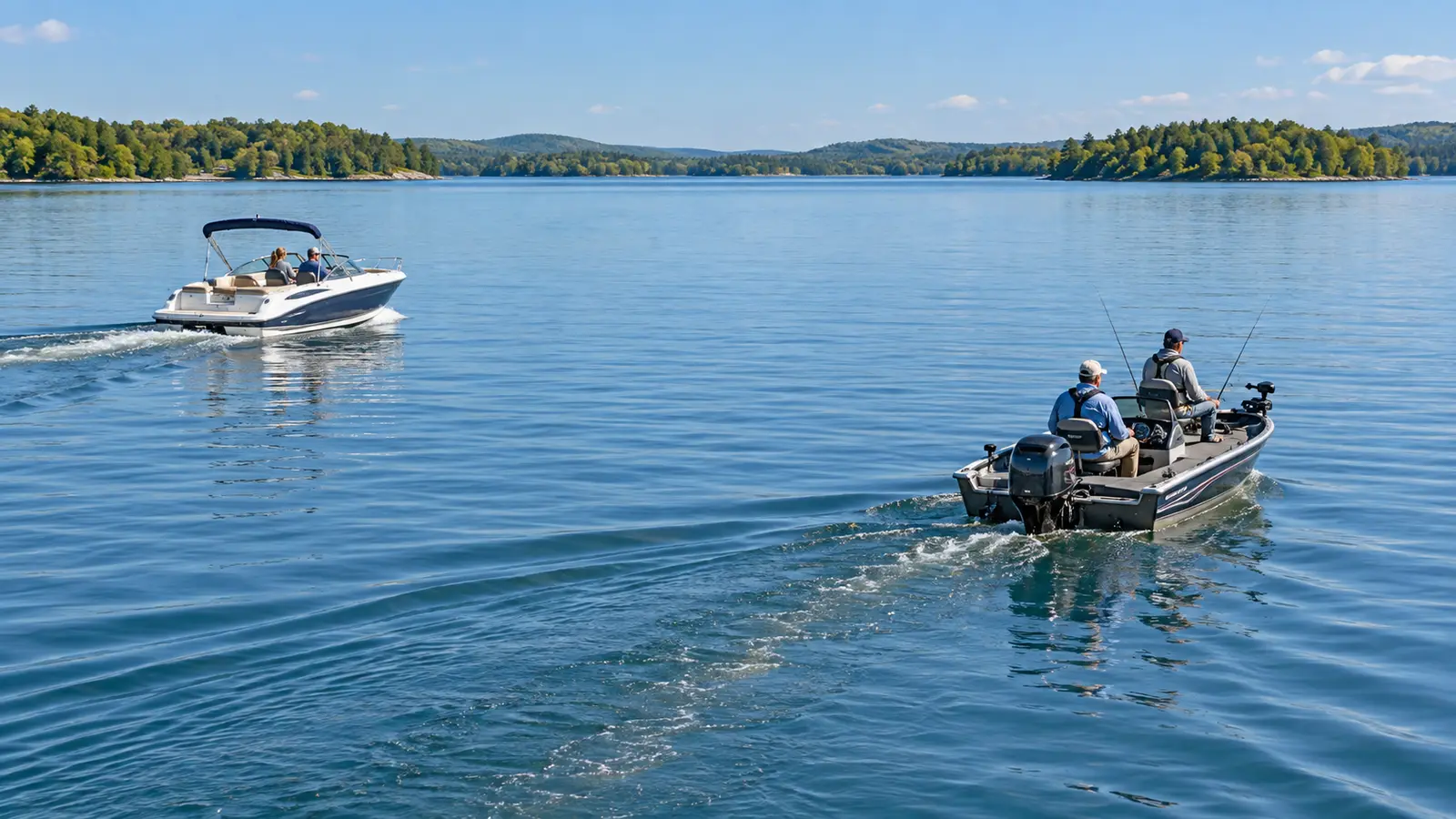
If you are overtaking a fishing boat, you are the give-way vessel. Slow down before you get close, maintain a proper lookout, choose a route with ample clearance, control your wake and stay clear until the other boat is finally past. Do not assume every fishing boat must be passed on a specific side. Waterway layout, traffic, visible fishing gear, signals and local rules determine the safest side.
Quick answer: How should you pass a fishing boat?
Reduce speed early, determine whether you are overtaking or crossing, and make one clear maneuver that leaves a safe distance. If overtaking, keep out of the way regardless of the other boat's type. Pass only when you can see a clear route, avoid visible lines or gear, minimize wake and monitor the fishing boat until you are fully past. In narrow channels or close-quarters situations, use the sound signals and communication required by the applicable Navigation Rules.
The first rule is not “port” or “starboard”
Many short answers say to pass a fishing boat on one fixed side. That is too simple. The official rules first ask what relationship exists between the vessels: overtaking, head-on or crossing. They also account for narrow channels, traffic separation, visibility and whether a boat is legally “engaged in fishing.”
Under U.S. Coast Guard Rule 13, an overtaking vessel must keep out of the way of the vessel being overtaken. If you are unsure whether you are overtaking, you should assume that you are. Your responsibility continues until you are finally past and clear.
How to pass a fishing boat step by step
1. Identify the situation before changing course
Maintain a proper lookout by sight, hearing and every appropriate available means. Watch the other boat's course, speed and apparent activity. Look for swimmers, paddlers, marker buoys, nets, lines, planer boards or other gear in the water. Check depth, channel edges, nearby traffic and your available stopping and turning room.
When risk of collision is uncertain, treat it as real until you have enough information. A series of small last-second course changes is harder for the other operator to interpret than one early, substantial and obvious maneuver.
2. Slow before you enter the fishing boat's immediate area
Use a speed that lets you take effective action and stop within an appropriate distance. The Coast Guard's safe-speed rule considers visibility, traffic density, maneuverability, wind, sea state, current, hazards and depth. A posted speed limit is not permission to throw a damaging wake.
Reduce speed while you still have room to do it smoothly. Avoid dropping off plane at the closest point if that creates a larger wake beside the anglers. Every hull reacts differently, so watch the actual wake behind your boat and adjust early.
3. Choose the side with the safest route and widest practical clearance
You may be able to pass on either side in open water, but only one route may be sensible. Favor the side with deeper water, fewer hazards, less traffic and no visible fishing gear. Do not squeeze between a fishing boat and the shoreline, a marker, a dock or another vessel simply because the gap looks technically wide enough.
If the fishing boat is trolling or has lines extending from the stern or sides, stay well outside the gear. Never cut closely across the stern. If you cannot determine where the lines are, slow further, increase the distance and wait for a clearly safe opportunity.
4. Communicate when the rules or circumstances call for it
Inland and International sound-signal meanings are not identical in every situation. On U.S. inland waters, power-driven vessels meeting, crossing or overtaking at close range may need to exchange whistle signals. In a narrow channel, Rule 9 adds specific overtaking procedures. A radiotelephone agreement may also apply where the rules and equipment allow it.
Do not improvise a horn signal from memory. Review Rules 9, 13 and 34 in the Coast Guard's current compilation and know whether Inland or International Rules govern the water. If the other vessel's intention is unclear or the pass does not look safe, do not force it.
5. Hold the reduced speed and keep watching
A pass is not complete when your bow reaches the other boat. Keep your distance and wake under control as your stern moves by. Watch for a course change, a person standing, a fish being landed or gear entering the water. Do not accelerate until your entire boat and wake are safely clear.
Which side should you pass a fishing boat on?
There is no universal “always port” or “always starboard” answer for overtaking a fishing boat in open water. The passing side must be safe for the actual waterway and consistent with the applicable Navigation Rules and any exchanged signals.
| Situation | What controls the decision | Safe operating principle |
|---|---|---|
| Overtaking in open water | Rule 13, traffic, depth, hazards, gear and available clearance | The overtaking vessel keeps out of the way until finally past and clear. |
| Crossing situation | Rule 15 and the relative position of the two power-driven vessels | The vessel with the other on her starboard side generally keeps out of the way and should avoid crossing ahead when circumstances allow. |
| Narrow channel or fairway | Rule 9, channel limits and applicable overtaking signals | Do not assume an open-water pass. Signal and obtain a safe passing agreement where required. |
| Restricted visibility | Rule 19, radar and sound signals | Use a safe speed adapted to visibility and do not rely on visual overtaking assumptions. |
Why should boaters slow down while passing recreational fishing boats?
Slowing down provides more time to understand the scene, makes a course correction more effective and can reduce the wake reaching a small boat. Anglers may be standing, handling hooks or landing a fish. Loose tackle, coolers and rods may shift if a steep wake arrives from the side.
Wake depends on hull, speed, trim, load, distance and water depth. “Slow” is not one number for every boat. Operate so your actual wake does not create unnecessary danger or damage, and obey posted no-wake zones. If there is not enough room to pass without a disruptive wake, wait.
A fishing boat does not always have special navigation status
The Navigation Rules use “vessel engaged in fishing” as a technical category. It means a vessel using nets, lines, trawls or other fishing apparatus that restricts maneuverability. The definition specifically excludes trolling lines or other gear that does not restrict maneuverability.
That distinction matters. A recreational boat with people holding rods is not automatically a privileged vessel. A power-driven vessel legally engaged in fishing does receive specific treatment under Rule 18, but Rule 18 itself yields to the overtaking requirements of Rule 13 and certain narrow-channel and traffic-separation rules.
Do not turn this distinction into an argument on the water. Even when the other boat is not legally “engaged in fishing,” every operator still has a duty to avoid collision and take precautions required by good seamanship and special circumstances.
Special situations that change the plan
- Anchored fishing boat: Give the boat, anchor line and swing radius generous room. Pass with minimal wake and never run between the boat and a visible anchor marker or line.
- Trolling boat: Look for lines, boards or gear astern and to the sides. If the gear pattern is uncertain, wait or pass much farther away.
- Narrow channel: The channel may leave no safe passing route. Rule 9 and the correct overtaking signals control. A fishing vessel must not impede a vessel that can safely navigate only within the channel.
- Night: Identify navigation lights before deciding what the other vessel is doing. Fishing-vessel lights and shapes have specific meanings under Rule 26.
- Fog or heavy rain: Rule 19 applies when vessels are not in sight of one another. Reduce to a safe speed for restricted visibility and use radar and sound signals properly when available and required.
- People in the water: Stop the pass and keep well away. Watch for dive flags, swimmers and people entering or leaving a boat.
Common passing mistakes
- Assuming a fishing boat must always be passed on the same side
- Waiting until close aboard to reduce speed
- Passing close astern without checking for lines or gear
- Accelerating before the stern and wake are fully clear
- Making several small, ambiguous course changes
- Trusting that “stand-on” means the other operator can ignore collision risk
- Using memorized sound signals without confirming whether Inland or International Rules apply
- Forcing a pass in a narrow channel, at a blind bend or near a ramp and dock area
Before you pass: 10-second checklist
- ☐ Proper lookout maintained
- ☐ Overtaking, crossing or head-on situation identified
- ☐ Speed reduced early and wake checked
- ☐ Clear water, depth and traffic confirmed
- ☐ Fishing lines, gear, swimmers and markers located
- ☐ Passing side provides wide practical clearance
- ☐ Required signal or communication completed
- ☐ Boat monitored until finally past and clear
For the rest of the trip, use the boat fishing essentials checklist to review safety equipment, communication, weather and deck organization. The Fishing Boats hub connects the site's buying, electronics, sonar, setup and maintenance guidance.
Frequently asked questions
How should you pass a fishing boat?
If you are overtaking, slow early, maintain a proper lookout, keep well clear, pass only when the route is safe and remain clear until the fishing boat is finally past. Control your wake and account for visible lines, gear, nearby hazards and local rules.
Which side should you pass a fishing boat on?
There is no universal rule that every fishing boat must be passed on one particular side. Choose the side that provides the safest route and greatest practical clearance, then use the sound signals or communication required for the waterway. In a narrow channel, Rule 9 and the applicable Inland or International signals matter.
Why should boaters slow down while passing recreational fishing boats?
Slowing down gives the operator more time to assess movement and reduce collision risk. It can also reduce wake that may unsettle people, move unsecured equipment or make line handling more difficult. The correct speed depends on distance, hull, water and conditions, so a posted speed alone is not a complete wake decision.
Does a fishing boat always have the right of way?
No. Under the Navigation Rules, a vessel engaged in fishing is a specific category using gear that restricts maneuverability. Ordinary hook-and-line fishing or trolling that does not restrict maneuverability does not automatically create that status. Overtaking, narrow-channel, crossing and collision-avoidance rules still apply.
Sources and method
This guide summarizes collision-avoidance principles for U.S. recreational boaters. It does not claim a universal passing distance or replace the operator's assessment of current conditions. The legal distinctions and sound-signal notes were checked against current federal sources.
- U.S. Coast Guard Navigation Center: Amalgamated Navigation Rules
- eCFR 33 CFR 83.13: Overtaking
- eCFR 33 CFR 83.18: Responsibilities Between Vessels