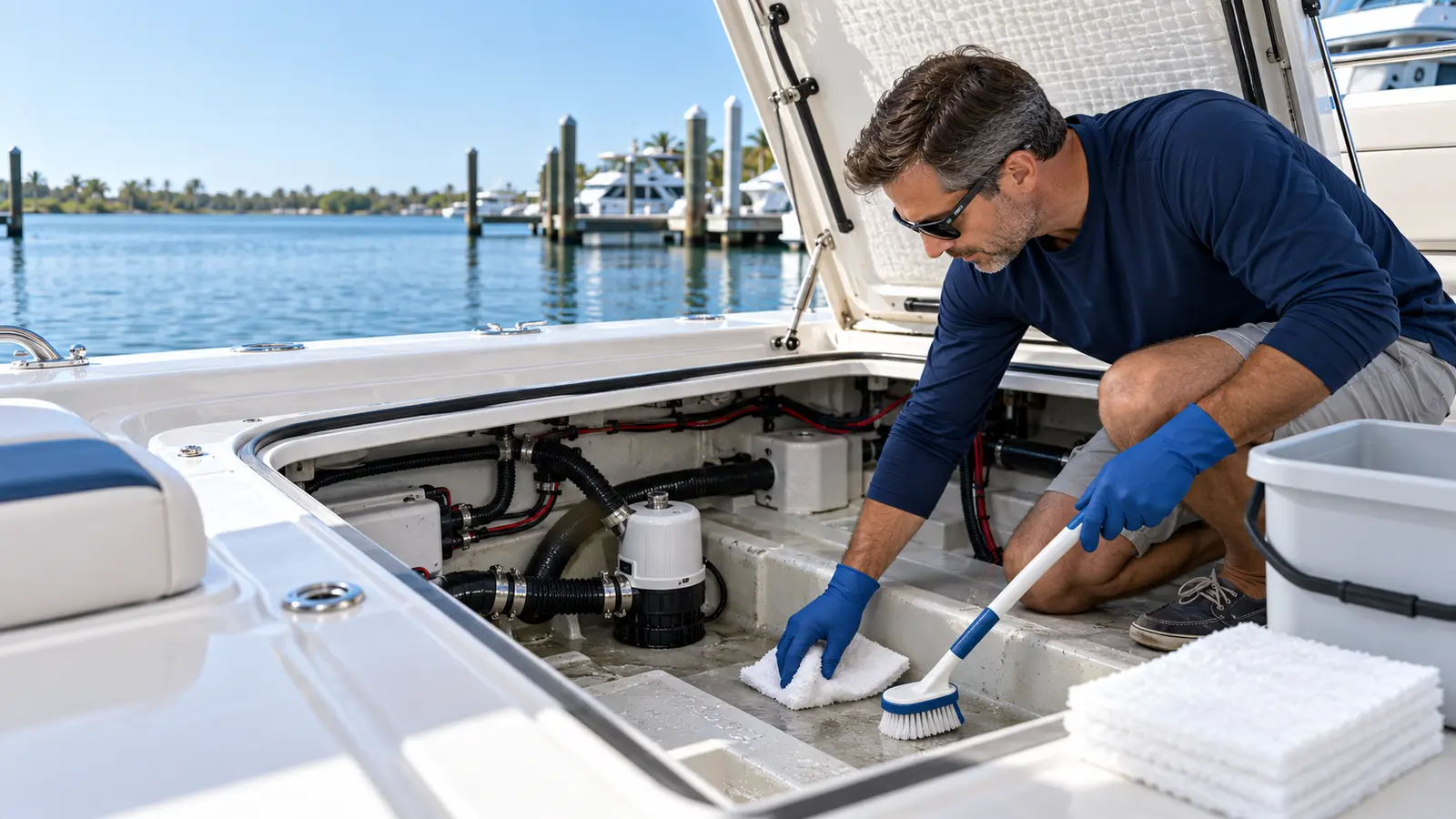
Editorial image of a generic bilge-cleaning setup. Follow your boat and equipment manuals for the actual installation.
The safest way to clean a boat bilge is to stop the source of contamination, prevent the automatic pump from sending dirty water overboard, remove dry debris and absorb oil before adding any cleaner. Collect every contaminated pad and liquid for proper disposal. Clean accessible surfaces with the least aggressive approved method, then inspect and test the pump, switch, hose, clamps and wiring according to their manuals.
Quick answer: the bilge-cleaning order
- Stop if you smell fuel, see an active leak or cannot identify the liquid.
- Keep oily or cleaner-contaminated water out of the discharge system and the waterway.
- Remove loose debris and use oil-only absorbent material before washing.
- Recover contaminated liquid using a method approved by the marina, yard or a qualified service provider.
- Use a compatible bilge cleaner only after the oil source is controlled.
- Rinse sparingly, recover the rinse water and dry accessible surfaces.
- Restore and test the bilge-pump system exactly as its instructions require.
Stop before cleaning in these situations
A bilge can collect rainwater and wash water, but it can also reveal fuel, engine oil, hydraulic fluid, coolant, sewage or a failed hose. Cleaning the evidence away before diagnosing it may turn a repair clue into a safety or pollution problem.
Also stop when liquid is rising, a through-hull or hose may be leaking, wiring is damaged, sewage is present, or access would put your weight on unsupported panels or moving machinery. Emergency dewatering and leak control come before cosmetic cleaning.
Contain the bilge before you disturb it
The U.S. Coast Guard's current recreational-boating guide explains that the Federal Water Pollution Control Act prohibits discharging oil in a quantity that causes a film, sheen, discoloration or sludge. State, local and marina rules can be more restrictive. Do not use detergent to make an oily sheen disappear and then pump the mixture out.
If the boat is afloat, plan containment with the marina before beginning. If it is ashore, protect drains and the ground. The automatic pump may need to be isolated during the controlled cleaning process, but only as the boat and pump instructions allow. Post a reminder and restore the system before the boat is unattended or returned to service.
Prepare a small, controlled work kit
- Nitrile or other chemical-compatible gloves and eye protection specified by the cleaner label
- Oil-only absorbent pads or a bilge boom for petroleum residue
- A scoop, grabber or disposable towels for dry debris
- A soft brush that reaches without striking wiring or switches
- Compatible, labeled containers for recovered liquid and used absorbents
- A marine bilge cleaner approved for the surface and equipment, if cleaning is still needed
- Good lighting designed for the location, with no exposed ignition source
Do not bring a household shop vacuum into a bilge where fuel vapor or flammable liquid is possible. Do not mix cleaners. Read the product label and safety data sheet before opening the container.
Identify what is in the bilge
Appearance and odor are clues, not a laboratory diagnosis. Photograph the condition before cleaning and note the fluid level. Drying the area after containment can help reveal where fresh liquid first appears.
| What you notice | Possible source to investigate | Immediate response |
|---|---|---|
| Clear water after rain or washing | Deck drain, hatch seal, plumbing, shaft seal or washdown overspray | Trace the entry point before assuming it is harmless |
| Rainbow sheen or oily film | Engine oil, grease, hydraulic fluid or fuel | Prevent discharge, absorb the petroleum and locate the leak |
| Strong gasoline odor | Fuel line, tank, fitting or spill | Stop work, avoid switches and ignition sources, and get qualified help |
| Colored or sweet-smelling liquid | Coolant from a closed-cooling system or another onboard fluid | Contain it and compare with the equipment manual before cleanup |
| Dark slime and stale odor | Long-standing water, organic debris or poor drainage | Remove solids, recover the water and investigate why it remains |
| Sewage odor or sanitary waste | Holding tank, hose or fitting | Use appropriate sanitation precautions and a qualified service provider |
How to clean a boat bilge step by step
1. Make the boat and work area safe
Secure the boat, open only the access panels identified by the manufacturer and keep the work area ventilated as the manual directs. Isolate machinery and electrical circuits only through the documented procedure. Never assume that a battery switch makes every wire in the bilge dead.
2. Remove leaves, sand and loose debris
Pick up solids before they reach the pump inlet. Work slowly around float switches, sensors and wiring. A clogged strainer is not the only risk: a small object can hold a switch, damage an impeller or restrict a hose.
3. Absorb petroleum before adding water
Place oil-only absorbent material on the surface and beneath the suspected drip. Replace it until it no longer collects fresh oil. Seal used pads in the container specified by the marina or local waste authority. An absorbent pad controls the residue; it does not repair the leak.
4. Recover contaminated liquid
Use the marina's collection service or compatible transfer equipment selected for the liquid. Do not run the boat's bilge pump to empty an oily or chemical mixture. A boatyard can advise where recovered bilge water and absorbents are accepted. Use the Boating Near You directory to research nearby marine services, then confirm current waste-handling capability directly.
5. Clean accessible surfaces gently
After the source is controlled and petroleum residue has been removed, apply the minimum amount of an approved bilge cleaner to a small test area. If you are learning how to use bilge cleaner, the product label and the boat manufacturer's material guidance take priority over a generic dilution recipe. Agitate only reachable surfaces with a soft brush. Do not soak electrical connectors, labels, sensors, sealants or sound insulation.
6. Rinse sparingly and recover the rinse water
Use only enough water to lift the remaining residue. Capture it rather than flooding the space and pumping it out. More water can spread contamination into inaccessible pockets and make drying harder.
7. Dry, inspect and restore the system
Wipe accessible surfaces dry and check whether fresh liquid returns. Inspect the pump inlet or strainer, automatic switch, fuse or breaker, accessible wiring, discharge hose, clamps and through-hull. Follow the exact pump manual before removing a strainer or lifting the pump from its base. Restore every circuit and safety function, then perform the manufacturer's pump and automatic-switch test.
How to choose and use a bilge cleaner
The best way to clean boat bilge residue is not necessarily the strongest degreaser. Start with the contamination and the materials present. A cleaner must be compatible with gelcoat or paint, hoses, pump components, wiring insulation, sealants and any sound-deadening material it may contact. The most useful bilge cleaning tips all begin with containment, compatibility and a disposal plan.
- Confirm the job: A cleaner removes residue after a leak is controlled. It does not make contaminated water suitable for discharge.
- Check compatibility: Use the boat and equipment manuals plus the cleaner label. Do not assume a household product is marine-safe.
- Use the minimum amount: More chemical creates more liquid that must be recovered.
- Never mix products: Bleach, acids, ammonia, solvents and degreasers can create hazardous reactions or damage materials.
- Plan disposal first: Know where the used solution, rinse water and absorbents will go before opening the bottle.
For the rest of the boat, use the separate whole-boat cleaning sequence. It covers decks, hull finishes, vinyl, glass and metal without turning a bilge procedure into a universal wash method.
Clean around the bilge pump without creating a new failure
A pump that looks clean can still have a blocked inlet, stiff switch, damaged wire or loose hose. A spotless compartment is not proof that the dewatering system works. Treat the pump and its automatic control as safety equipment.
- Read the exact pump and switch instructions before touching the assembly.
- Photograph wiring and hose routing before moving any serviceable part.
- Remove loose debris without pulling on wires, twisting the hose or changing the switch position.
- Do not bypass a fuse, switch or alarm to make the pump run.
- After reassembly, test manual and automatic operation as the manufacturer specifies.
- Confirm the discharge outside the hull is clear and that no recovered cleaning waste is released.
Add the result to the boat maintenance checklist. If the pump cycles repeatedly or the bilge refills, investigate the water source instead of treating frequent pumping as normal.
Seven bilge-cleaning mistakes to avoid
- Pumping first: An automatic pump can send an oily sheen or cleaner mixture straight overboard.
- Masking the odor: Fragrance does not identify or repair a fuel, sewage or stagnant-water problem.
- Adding detergent to oil: Emulsifying oil can hide the sheen while leaving polluted water.
- Using a household vacuum: Unknown vapor or liquid can make ordinary electrical equipment unsafe.
- Pressure washing the compartment: High pressure can drive water into connectors, switches, insulation and inaccessible spaces.
- Moving the float switch casually: A changed angle or obstructed arm can prevent automatic operation.
- Leaving the pump disabled: A temporary cleaning setup becomes dangerous if the system is not restored and tested.
Keep the bilge clean enough to reveal problems
A useful bilge is not merely bright. It is dry enough and uncluttered enough that new contamination is obvious. Inspect it after heavy rain, washing, service work, fueling and any trip where the pump ran. Keep an oil-only absorbent pad where the boat and equipment manufacturers permit, and replace it before it becomes saturated or interferes with the pump or switch.
Fix the source of recurring water. Check hatch seals, drains, plumbing, engine systems and through-hull connections as appropriate to the boat. Build those repairs into the Boat Maintenance guides and the annual maintenance budget. A recurring leak deserves a repair line item, not a larger bottle of cleaner.
Bilge-cleaning completion checklist
- The source of oil, fuel, coolant, sewage or incoming water was identified or referred for diagnosis.
- No contaminated liquid was pumped into the water, a storm drain or the ground.
- Used pads, debris and recovered liquid are in compatible, labeled containers for approved disposal.
- No cleaner was mixed with another chemical or left pooled in the bilge.
- Pump, switch, hose, clamps, fuse or breaker and accessible wiring were inspected.
- Temporary electrical isolation was removed and every access panel was secured.
- Manual and automatic pump tests passed according to the equipment instructions.
- The bilge was rechecked for fresh liquid after cleaning.
Why there is no product recommendation on this page
BoatOwner Hub checked the current published review catalog before preparing this guide. It does not yet contain a verified bilge cleaner, oil-only absorbent, containment kit or bilge-service review. A scuff eraser, battery charger or general deck accessory would not solve this reader problem, so no affiliate product is being forced into the article. When a relevant product review is published and source-checked, it can be connected here without changing this page's URL or publication date.
Boat bilge cleaning questions
Can you pump dirty bilge water overboard?
Do not discharge bilge water that contains oil, fuel, cleaner or other contamination. Contain it and ask the marina, yard or local waste authority how to dispose of it. Federal law prohibits an oil discharge that causes a sheen, and state or local rules may be stricter.
What should you use to clean a boat bilge?
Start with dry debris removal and oil-only absorbent material. If surface cleaning is still needed, use a product approved by the boat or equipment manufacturer, follow its label and safety data, use the minimum amount, and recover the wash water.
Can you use bleach or household degreaser in a bilge?
Do not improvise with bleach, solvents or household degreasers. They may damage materials, react with other chemicals or create contaminated water. Never mix cleaners.
How often should you clean a boat bilge?
There is no single interval for every boat. Inspect it frequently enough to catch new water, oil, odor or debris before the condition becomes normal, and clean promptly after resolving the source.
Should you clean around the bilge pump?
Yes, but only with the power and access precautions in the boat and pump manuals. Remove loose debris without damaging the pump, switch, wiring, hose or clamps, then restore and test the system before returning the boat to service.
Sources and editorial method
BoatOwner Hub checked pollution and containment guidance against current U.S. Coast Guard material, EPA clean-boating guidance and NOAA marina resources on October 5, 2026. The cleaning sequence is editorial guidance designed to keep contaminated liquid contained and to defer model-specific electrical, pump, fuel and disposal instructions to the boat, equipment, marina and local authority. We did not claim hands-on testing or recommend an unverified product.
- U.S. Coast Guard: A Boater's Guide to the Federal Requirements for Recreational Boats
- U.S. EPA: clean-boating guidance for oily bilges
- NOAA Channel Islands National Marine Sanctuary: responsible boating resources