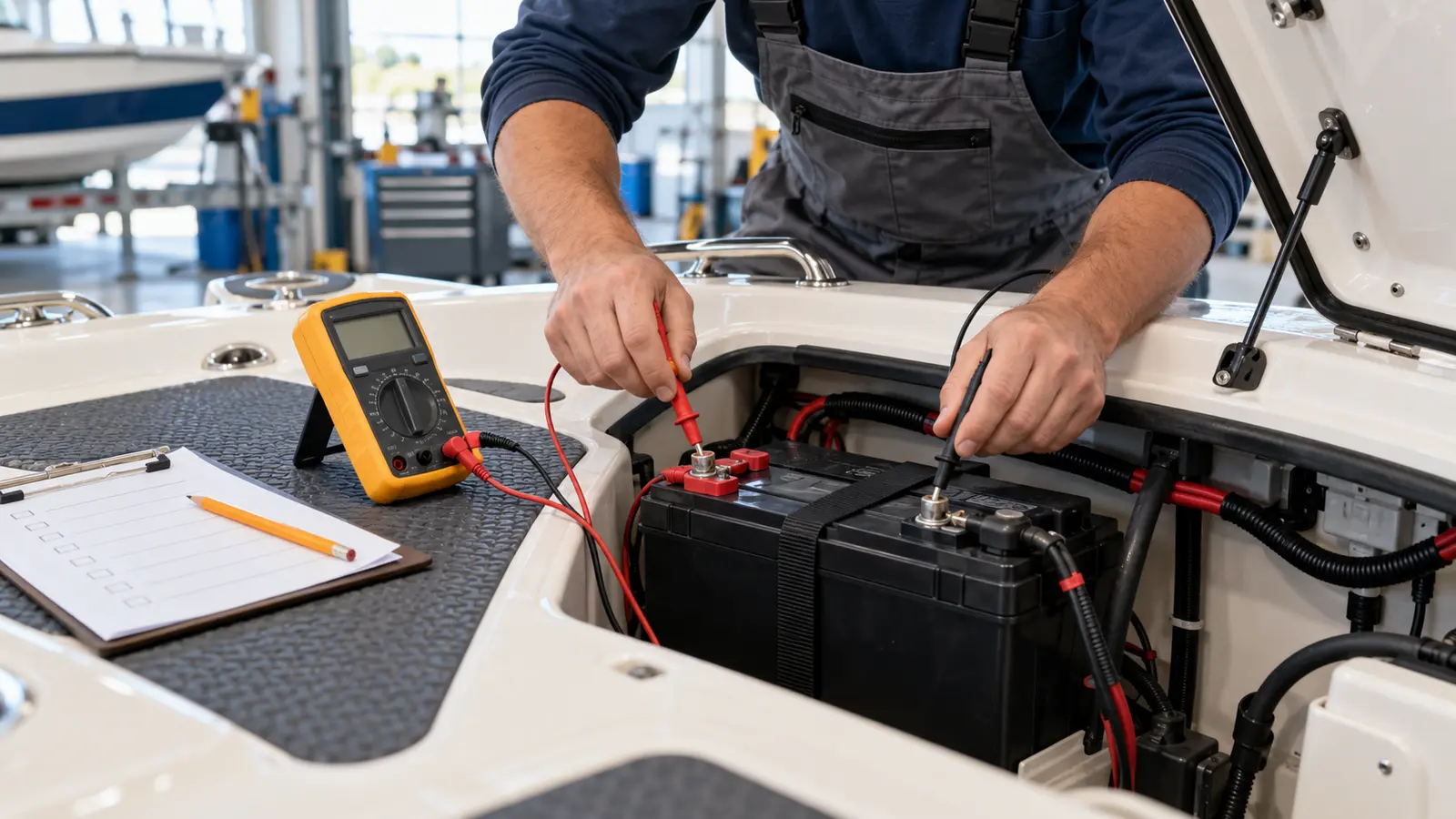
A multimeter can show polarity and terminal voltage. It cannot, by itself, measure the battery’s true amp-hour capacity or prove that voltage will remain stable under a heavy load.
Before measuring
- Identify the battery chemistry and nominal voltage from its label.
- Turn off charging sources and loads using the vessel’s approved procedure.
- Allow surface charge to dissipate for the period recommended by the battery maker.
- Set the meter to DC voltage and a range above the battery’s expected voltage.
Measure resting voltage
Place the red probe on the positive terminal and the black probe on the negative terminal without letting the probe tips touch each other. A negative reading usually means the probes are reversed. Compare the result with the battery manufacturer’s state-of-charge chart for that chemistry and temperature.
For context, Interstate’s glossary states that a fully charged 12-volt lead-acid battery produces at least 12.66 volts. That number should not be applied blindly to lithium, gel or every AGM product; use the maker’s chart.
What the result means
- Expected resting voltage: the battery may be charged, but capacity can still be poor.
- Low resting voltage: charge with compatible equipment before judging condition, unless the battery is damaged.
- Voltage falls quickly after charging: investigate battery condition and unwanted loads.
- Normal voltage but weak cranking: check capacity under load, cable condition, connections and the starting system.
Why a load or conductance test matters
A weak battery can display plausible voltage with no load, then collapse when the starter demands current. Use a tester designed for the battery type and rating, or have a battery or marine service center perform the test. Deep-cycle capacity testing is different from a simple starting-battery test and can take longer.
Check the charging system separately
Measure charging behavior only with the safe test procedure and specifications for the engine or charger. A higher running voltage does not automatically mean the charging system is correct; target ranges vary by battery chemistry, temperature and equipment.
Common testing mistakes
- Testing immediately after charging and treating surface charge as a stable result.
- Using a lead-acid voltage chart for lithium.
- Assuming voltage proves available capacity.
- Ignoring corroded or loose connections.
- Setting the meter to current mode and placing it across the battery terminals, which can create a dangerous short circuit.