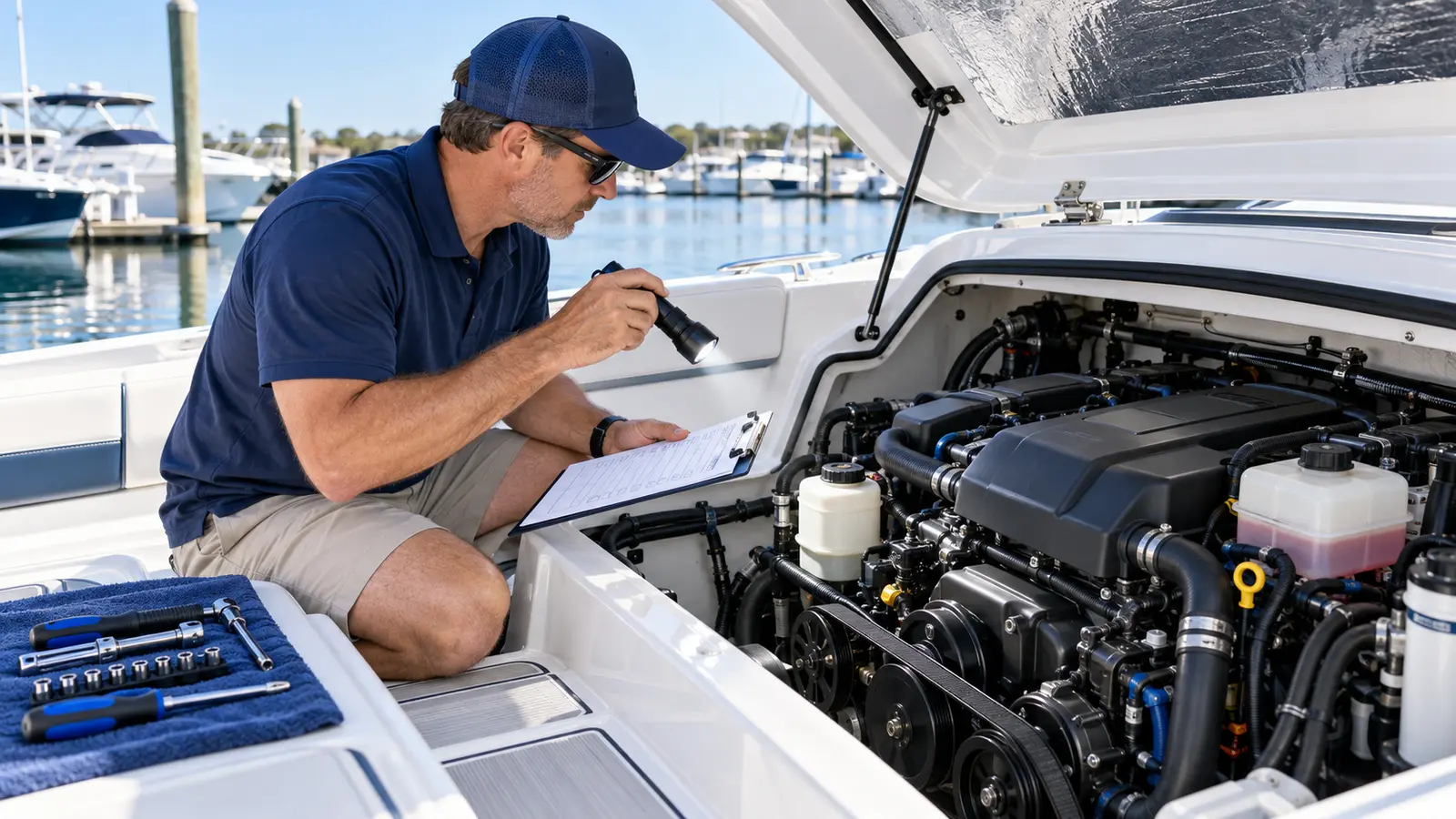
Editorial image of a generic inboard engine-space inspection. Your installed engine, drive and boat manuals control the actual procedures.
Good inboard boat engine maintenance starts with the serial number and the correct manuals, not a universal list of replacement intervals. Before every trip, look for leaks, damaged hoses, loose connections and poor ventilation. After starting, confirm normal gauges, cooling-water flow and exhaust behavior. Schedule fluid, filter, belt, cooling, fuel, ignition and drive service by both engine hours and calendar time exactly as the manufacturer specifies.
Quick answer: the owner maintenance loop
- Identify the exact engine, transmission or sterndrive, generator and installed fuel and cooling systems.
- Build one schedule from every applicable manufacturer manual, using both hours and dates.
- Inspect the engine space before starting, with the engine off and the area ventilated as directed.
- Observe gauges, alarms, exhaust-water flow, sound and vibration after start-up.
- Complete the manual's post-use care for fresh or salt water.
- Record every service, part, fluid, measurement and next due point.
- Stop for fuel odor, leakage, smoke, unusual heat, rising water, exhaust damage, repeated alarms or a new severe vibration.
Start with the exact manuals and serial numbers
"Inboard" covers gasoline and diesel engines, direct-drive and V-drive arrangements, and boats with separate transmissions, generators or sterndrives. Cooling may be raw-water cooled, closed cooled or a combination. One checklist cannot safely assign a single oil grade, coolant, filter, anode or service interval across those systems.
Find the model and serial number on the engine and drive. Download or retain the current operator manual, the boat builder's manual and manuals for the transmission, generator, charger and fire system. Mercury Marine directs owners to identify the correct MerCruiser manual by engine information, while Volvo Penta and Yanmar also provide model-specific owner support. If the boat is new to you, ask a qualified technician to establish a baseline service instead of assuming the previous log is complete.
Before-start inboard maintenance checklist
Inspect only when the engine cannot start unexpectedly, moving parts are stopped and hot surfaces have cooled. Keep the key or start control under your control. Do not enter a machinery space with suspected fuel vapor or exhaust gas.
| Area | Owner check | Stop and escalate when |
|---|---|---|
| Bilge and engine pan | Look for new water, oil, coolant or fuel; compare with the last inspection | Fuel is present, water is rising or the source is unknown |
| Fuel system | Use sight and smell from a safe position; inspect accessible hoses and fittings without opening the system | There is fuel odor, staining, wetness, cracking or a loose fitting |
| Fluids | Check engine oil, coolant reservoir and transmission or drive fluid as each manual directs | A level changes suddenly, fluid looks contaminated or a leak is active |
| Belts and hoses | Look for glazing, fraying, swelling, cracks, soft spots and loose clamps | A belt is damaged or a hose, clamp or exhaust component is suspect |
| Battery and wiring | Check secure hold-downs, covered terminals and visible cable condition | There is heat, swelling, leakage, corrosion damage or melted insulation |
| Ventilation | Keep ducts and openings unobstructed; use the blower exactly as the boat label and manual specify | The blower fails, airflow is uncertain or gasoline vapor is suspected |
For gasoline inboards, ventilation is a primary safety system. Do not treat the blower as proof that a fuel leak is safe. If you smell gasoline, do not operate switches or start the engine. Remove ignition sources, keep people away and follow the boat's emergency procedure.
After starting: observe before leaving the dock
Start only by the documented procedure. Watch oil pressure, temperature, voltage and warning indicators. Confirm the normal cooling-water or wet-exhaust behavior described by the engine manual. Listen for a new knock, squeal, rattle or irregular exhaust sound, and feel for vibration from a safe position without approaching moving belts or shafts.
- Allow the engine to stabilize at the manual-specified idle.
- Check the engine space for leaks only from a safe access point.
- Test steering and shift response at idle while securely moored and clear of people.
- Stop if an alarm persists, a gauge is abnormal, cooling flow is missing, exhaust enters occupied areas or the engine develops a new vibration.
The U.S. Coast Guard warns that carbon monoxide can accumulate in and around a boat, even in open areas. Keep people away from exhaust outlets and maintain marine-rated carbon-monoxide detection where the boat design and safety guidance call for it.
After-use care
Follow the engine maker's post-use procedure for the water where the boat operated. Saltwater use may require a documented flushing process, exterior rinsing, corrosion inspection and attention to anodes or heat exchangers. Never invent a flushing connection or run an engine without the water supply and procedure specified for that model.
- Let the engine cool and make an engine-space walk-through.
- Look for fresh drips, salt deposits, belt dust, coolant residue or a new odor.
- Check the bilge and shaft or drive area for leakage.
- Rinse approved exterior surfaces and dry the space without spraying electrical components or air intakes.
- Log engine hours, fuel use, alarms, vibration and anything that changed.
Fuel, ventilation and exhaust
Fuel, air and exhaust faults can be immediately dangerous. Inspect accessible fuel hoses, fill and vent components, filters and water separators only as the manuals allow. Do not tighten a fitting casually, open a pressurized system or use an automotive electrical component in a gasoline engine space.
Check exhaust hoses, clamps, water-injection components and mufflers for staining, corrosion, softness, cracks or heat damage. Confirm that exhaust outlets stay clear. The Coast Guard carbon-monoxide checklist recommends checking exhaust clamps and confirming expected water flow from the exhaust when engines and generators start. A qualified technician should evaluate any damaged exhaust part or exhaust odor in occupied spaces.
Cooling-system maintenance
Cooling service depends on whether the engine uses raw water, a closed freshwater circuit, a heat exchanger, a seawater pump or a combination. The manual defines the coolant type, test method, drain points, pump and impeller service, heat-exchanger work, anodes and winter protection.
- Keep raw-water intakes and strainers clear by the documented method.
- Inspect accessible hoses and clamps for damage or seepage.
- Check coolant only when the manual says it is safe. Never open a hot pressurized cap.
- Record the last pump, impeller, thermostat, coolant and heat-exchanger service.
- Treat an overheat alarm as real. Follow the shutdown procedure and do not keep running to test it.
If an overheat or weak cooling flow appears during operation, use the symptom-first steps in the common boat maintenance problems guide.
Engine oil, filters and transmission fluid
Use only the oil, filter and transmission or drive fluid specifications approved for the exact model. Check levels at the temperature, trim and boat attitude the manuals require. Overfilling can be as harmful as running low.
During service, note the drained fluid's appearance without claiming that color alone diagnoses a fault. Water, metal, fuel odor, heavy debris or an unexplained level change needs professional evaluation. Replace sealing washers and filters as specified, verify for leaks after restart, and record the part numbers and quantity used.
Belts, hoses, mounts and controls
Inspect belts for cracks, glazing, missing material and contamination. Check hoses for swelling, chafe, soft spots, cracking and contact with moving or hot parts. Do not apply a generic tension rule because the correct method and specification vary.
Engine mounts, coupling alignment, shift cables and throttle controls affect both reliability and control. Owners can look for loose visible hardware, corrosion, movement marks and changed control feel. Alignment, critical fastener torque and internal control work require the approved procedure and often professional tools.
Battery and engine-room electrical checks
Confirm that batteries are restrained, terminals are protected and cables are supported away from heat and abrasion. A repeated low-battery symptom can come from battery condition, poor connections, charging output or an unintended load. The boat battery test guide explains safe basic measurements, and the battery troubleshooting guide separates those causes.
Do not work live in a gasoline engine space, bypass overcurrent protection or substitute an automotive part for required marine equipment. Stop for heat, arcing, melted insulation, swelling, leakage or damage to high-current conductors.
Shaft, propeller and running gear
With propulsion fully disabled and the starting control secured, inspect the propeller and accessible running gear for fishing line, impact damage, missing hardware, corrosion and new leakage. Check shaft seals or stuffing-box areas by the boat and component instructions. A new vibration, shaft-seal leak, coupling movement or evidence of a strike calls for a qualified inspection.
Do not reach near the propeller while another person can start the engine. A line removed from a shaft may already have damaged a seal, so keep monitoring for leakage and follow the service guidance.
Gasoline and diesel maintenance are not interchangeable
| System | Gasoline inboard emphasis | Diesel inboard emphasis |
|---|---|---|
| Ventilation | Fuel-vapor control and ignition protection are critical; use the blower and checks in the boat manual | Maintain required airflow and keep the space clear, while following diesel-specific ventilation guidance |
| Ignition and starting | Ignition components and spark-plug service may apply | Glow or intake-heater systems and high compression require different diagnostics |
| Fuel | Stop immediately for gasoline odor or leakage | Manage water separation, filtration and bleeding only by the engine manual |
| Service schedule | Use the exact gasoline engine and drive schedule | Use the exact diesel duty rating and periodic-maintenance schedule |
Do not transfer a YouTube procedure, fluid or part between engines because they look similar. Yanmar's marine guidance points owners to the Periodic Maintenance section of the specific Operation Manual, and its published examples use model-dependent hour bands rather than one universal interval.
Seasonal layup and recommissioning
Winterization can involve raw-water draining or antifreeze procedures, closed-cooling protection, fuel treatment, oil service, battery care, corrosion protection and drive or transmission work. The exact sequence depends on the engine, climate and storage method. Follow the boat winterization overview, then use the engine and boat manuals for every system-specific step.
Recommissioning is a checklist of its own. Restore any disconnected systems, inspect cooling and exhaust components, verify fluids and battery condition, confirm seacock positions by the boat procedure, and complete a controlled dock test before open-water operation.
What an owner can check and when to call a technician
| Often reasonable for an owner when the manual permits | Use a qualified marine technician |
|---|---|
| Visual leak, belt, hose, wire and corrosion checks | Fuel leaks, tank work or uncertain gasoline-vapor conditions |
| Fluid-level checks and service-log updates | Internal engine or transmission repair |
| Approved exterior cleaning and documented post-use care | Exhaust-system faults or carbon-monoxide concerns |
| Manual-approved filters, fluids or strainers with the right tools | Shaft alignment, coupling, mount or severe vibration diagnosis |
| Basic battery condition and connection inspection | Damaged high-current wiring or work outside safe isolation procedures |
Build an inboard boat maintenance schedule that stays usable
Make one row for each task and include the applicable engine-hour interval, calendar interval, last completion, next due point, specification, part number and responsible person. Keep receipts and fluid notes with the log. The broader boat maintenance checklist can coordinate the engine with bilge, battery, safety-equipment and trailer work, while the maintenance cost guide helps build an annual budget.
For owners comparing propulsion types, the outboard motor maintenance guide explains the different access, cooling and post-use pattern. Keep the two schedules separate.
Maintenance mistakes to avoid
- Using a universal interval: Engine hours, calendar time, engine family and duty all matter.
- Ignoring the drive and transmission: The engine is only one part of the propulsion package.
- Opening a hot cooling system: Pressurized coolant can cause severe injury.
- Treating a blower as a leak repair: Gasoline odor is a stop condition.
- Running through an alarm or vibration: Continuing can compound damage or reduce control.
- Skipping the log: Without dates and hours, it is easy to miss the earlier of two due points.
Inboard boat maintenance questions
What maintenance is recommended for an inboard boat?
Recommended maintenance starts with the exact engine, transmission or drive, generator and boat manuals. Typical owner checks cover fuel or water leaks, ventilation, cooling-water flow, fluid condition, belts, hoses, battery connections, exhaust components and running gear. The manual sets the actual tasks and intervals.
How often should an inboard boat be serviced?
Use the model-specific hour and calendar intervals in the engine and drive manuals, whichever applies first. Also inspect the engine space before use, observe gauges and exhaust-water flow after starting, and perform the specified post-use and seasonal care.
Can an owner maintain an inboard engine?
Owners can usually perform documented visual checks, cleaning, recordkeeping and selected fluid or filter work when the manuals permit it. Fuel leaks, exhaust faults, internal engine work, alignment, high-current wiring and unfamiliar procedures should go to a qualified marine technician.
Does saltwater change an inboard maintenance plan?
Saltwater increases the importance of the engine maker's flushing or post-use procedure, corrosion inspection, anode checks where fitted, cooling-system care and freshwater rinsing of approved exterior surfaces. Follow the exact manual because raw-water and closed-cooling layouts differ.
What should be recorded in an inboard engine service log?
Record the date, engine hours, operating conditions, fluid and filter specifications, parts, measurements, alarms, observed leaks or vibration, who performed the work and the next hour or calendar due point.
Sources and editorial method
BoatOwner Hub checked safety boundaries and manual-first maintenance planning against primary U.S. Coast Guard and engine-manufacturer resources on October 13, 2026. The checklist is editorial guidance. Exact procedures, parts, fluids, alarms and intervals must come from the manuals for the installed equipment.
- U.S. Coast Guard: Carbon Monoxide Checklist
- U.S. Coast Guard: Carbon Monoxide Protection
- Mercury Marine: Owner's Manuals
- Volvo Penta: Support and Manuals
- Yanmar Marine: Maintenance and Manual FAQs