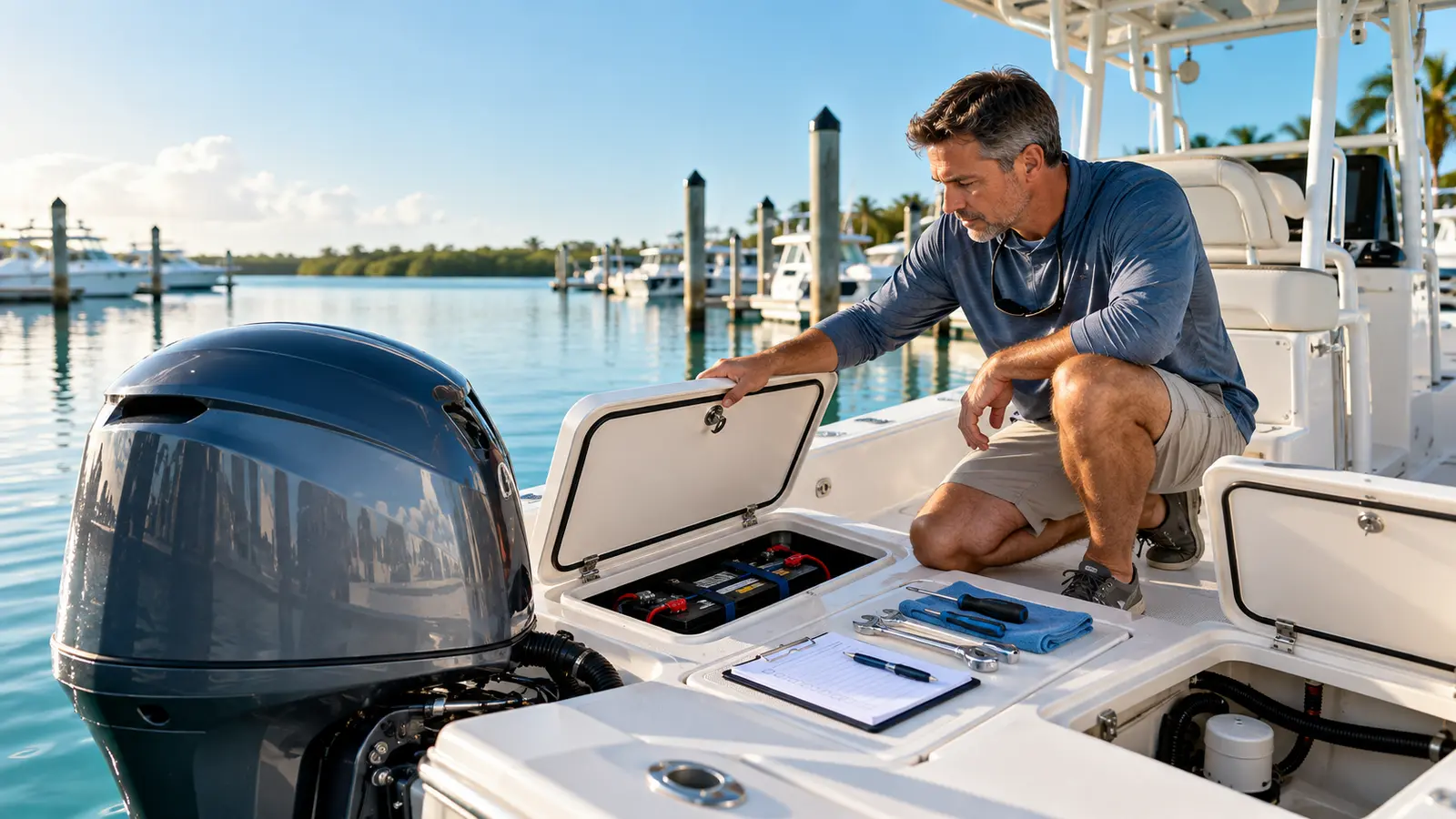
Editorial image of a generic inspection. Use the manuals and qualified service guidance for your actual boat and equipment.
The best response to common boat maintenance issues is not to replace parts at random. Record the exact symptom, make the boat safe, check the simplest manual-approved causes, and change one condition at a time. Fuel odor, rising water, smoke, fire, unusual heat, steering loss or a repeated warning alarm are stop conditions, not invitations to keep testing.
Quick answer: use this troubleshooting order
- Secure the boat and account for people, traffic, current and weather.
- Stop for fuel, fire, smoke, heat, rising water or loss of control.
- Read the active warning and the exact owner manual before resetting anything.
- Write down when the symptom began: cold start, idle, acceleration, cruise, docking or after service.
- Inspect power, connections, fluids, hoses, controls and visible obstructions without bypassing safeguards.
- Test one documented item at a time and record the result.
- Escalate when the safe owner-level checks do not isolate the cause.
Before troubleshooting on the water, make sure the crew can reach the boat emergency kit, distress communications, life jackets and position information.
Stop troubleshooting in these situations
Some common boat problems become emergencies when testing continues. If you smell gasoline, do not start the engine or operate electrical switches. Extinguish ignition sources, keep people away and follow the boat manual's ventilation and emergency procedure. A leaking battery, hot cable, smoke or arcing also requires immediate isolation by the documented method and qualified help.
Unexpected water that is still rising comes before diagnosis. Put on life jackets, start the installed dewatering system only as its instructions allow, identify a safe route, call for assistance and prepare to leave the boat if needed. Do not remain in a machinery space or reach into moving, hot or energized equipment.
Match the symptom to the next safe check
| Symptom | Start with | Do not do |
|---|---|---|
| Engine will not crank | Control position, emergency-stop lanyard, battery switch, terminal condition and manual start sequence | Bypass a neutral switch, fuse or starter circuit |
| Engine cranks but will not start | Fuel level and age, tank selection, approved vent position, primer or pump procedure and active alarms | Spray starting fluid or open a fuel system casually |
| Overheat or warning alarm | Reduce load, follow the shutdown instruction, then inspect the cooling-water intake and visible obstructions when safe | Keep running to see whether the alarm clears |
| Stalling or power loss | Note rpm, load and fuel condition; check visible fuel restrictions and propeller condition using manual procedures | Assume the first suspected part is the cause |
| Battery repeatedly goes flat | Battery condition, connections, charging output, switches and hidden loads | Use a maintainer to hide an unresolved drain |
| Bilge pump cycles or water returns | Trace the source, inspect the pump inlet, switch, hose and discharge | Treat repeated pumping as normal |
| Steering is stiff or uneven | Stop operating, inspect visible linkages, fluid evidence and obstructions | Force the wheel or continue at speed |
| New vibration | Stop, secure propulsion, inspect the propeller and lower unit or running gear when safe | Accelerate through the vibration |
1. The engine will not start
Separate a no-crank condition from an engine that cranks normally but does not fire. That one observation prevents battery troubleshooting from being mixed with fuel or ignition diagnosis.
If the starter does not turn
- Confirm the control is in the manual-specified neutral position and the emergency-stop lanyard is attached correctly.
- Check the battery switch position and instrument voltage without cycling switches if fuel vapor is suspected.
- Look for a loose terminal, corrosion, damaged insulation, a hot connection or a tripped protection device. Do not bridge terminals or substitute a larger fuse.
- Use the boat battery testing guide only when the battery is accessible, undamaged and safe to test.
If the starter turns but the engine does not fire
Confirm fuel quantity, tank selection, portable-tank venting and the primer or fuel-pump sequence exactly as the manual specifies. Note whether the problem followed fueling, storage, a filter change or rough water. Water in fuel, stale fuel, a restricted line, a closed vent or an ignition fault can produce similar symptoms. Opening a pressurized fuel system or defeating an interlock is not an owner-level shortcut.
2. An overheat alarm or weak cooling-water stream appears
Treat the warning as real. Reduce throttle and shut down according to the engine manual. After the engine is secured and cool enough to approach, inspect the water intake for weeds, a plastic bag or other visible blockage. A weak indicator stream can also result from a blocked indicator outlet, pump damage, thermostat trouble or an internal restriction, so clearing one visible opening does not prove the cooling system is healthy.
Never run an outboard dry. Do not remove a hot pressure cap or place hands near a propeller that could move. The outboard maintenance guide explains flushing, service intervals and why an impeller schedule must come from the exact model manual.
Before treating a symptom as one failed part, use the boat fuel line guide to inspect hose condition, primer-bulb behavior, connector fit and the complete route.
3. The engine stalls, surges or loses power under load
Record the engine speed, boat load, sea state, fuel level and how quickly the symptom returns. A fuel restriction may appear only at higher demand, while a damaged propeller can make the engine sound normal but change acceleration and speed. Fouled spark plugs, sensor faults, restricted ventilation and internal engine problems can produce overlapping clues.
- Check the display or warning lamps before shutting the system down.
- Inspect the visible fuel line, primer bulb, filter bowl, tank vent arrangement and fittings for damage or collapse, without opening the system.
- Look at the propeller only after the engine is fully secured by the manual's procedure and the key or lanyard is controlled.
- Compare the result with the engine manual. If the symptom repeats, avoid extended operation and arrange diagnosis.
4. Fuel odor, leakage or difficult fueling
A fuel smell is a stop condition. Do not start the engine, connect a charger, smoke, use a non-ignition-protected device or operate switches that may spark. Close the fuel supply only when the installed system and emergency procedure identify a safe method. Ventilate as the boat manual directs and contact the marina or a qualified marine technician.
After safe repair, document when the odor appeared and whether it followed filling, a hot day, trailering or a component change. Inspect accessible hoses, clamps, fill and vent fittings only by the manufacturer's procedure. The new fuel keyword research is being mapped separately, so this page does not try to turn tank, line, filter and safe-refueling intents into one oversized repair guide.
5. The battery is weak or electrical power is intermittent
Start with condition and connections. A charged battery can still fail under load, while a healthy battery can be drained by a hidden load or left undercharged by a wiring or charging-system fault. Inspect the case, hold-down, terminal protection and accessible cables. Stop for swelling, leakage, heat, melted insulation or a damaged high-current connection.
Use the battery troubleshooting sequence to separate battery condition, charging output, connection loss and parasitic draw. The starting versus deep-cycle guide explains why the battery's job matters before replacement.

NOCO GEN5X2 two-bank charger
Useful for: charging two supported 12-volt batteries independently after battery condition, connections and charging needs have been checked.
Limitation: output is 5 amps per bank. A compatible charger does not repair a failed battery, hidden load, bad cable or engine charging-system fault.
Go to review pageConfirm chemistry, capacity, mode, installation and charging temperature against the battery and charger manuals.6. The bilge pump runs often or water keeps returning
Frequent cycling is a symptom, not a maintenance schedule. Check whether the water is fresh, salt, coolant, sewage, fuel or oily liquid before cleaning it away. Trace rain entry, plumbing, drain, shaft seal, through-hull, washdown and engine-system sources as applicable to the boat.
Inspect the pump inlet, automatic switch, fuse or breaker, hose, clamps and discharge outlet using the pump manual. Do not leave an automatic pump disabled after testing. If contamination is present, follow the bilge cleaning and containment guide instead of pumping it overboard.
7. Steering or throttle control feels stiff, loose or uneven
Do not force a wheel or control lever. Stop operating until the cause is known. Look for an external obstruction, visible fluid leak, damaged hose, loose hardware, corrosion or a change at the engine connection. Cable, hydraulic and electronic steering systems have different inspection and bleeding procedures, and critical fasteners can have model-specific torque and locking requirements.
Control-system work affects the ability to maneuver. If the fault is not a clearly documented owner check, use a qualified technician and verify full travel at the dock before any return to service.
8. New vibration, noise or reduced speed appears
Reduce power and stop if the vibration is new or severe. Once propulsion is safely disabled, inspect for a bent, chipped or fouled propeller, fishing line, impact evidence and loose visible hardware. On an inboard or sterndrive boat, running-gear, mount, alignment and bearing faults may need professional inspection.
Do not reach near the propeller with the key available to another person. Fishing line around a shaft can damage seals even when the line is removed, so monitor for leakage and follow the service manual after an entanglement or strike.
9. Trailer lights, hubs or brakes fail before launch
A trailer problem is part of boat maintenance because it can end the trip before the boat reaches the water. Do not tow with a damaged tire, loose wheel, hot hub, inoperative required light, uncertain coupler, failed breakaway system or brake fault. Saltwater immersion and storage age matter even when tread looks good.
Use the boat trailer maintenance checklist for tires, bearings, brakes, lights, coupling hardware and supports. Confirm service intervals and specifications with the axle, brake and trailer manufacturers.
Prevent propulsion symptoms with the inboard boat maintenance schedule, while keeping the exact engine and drive manuals in control of specifications and intervals.
Turn each failure into a prevention step
Once the cause is confirmed, record the date, engine hours, symptom, test result, repair, parts and next due point. Add the new check to the boat maintenance checklist, not to memory. A useful log helps distinguish a one-time obstruction from a recurring pattern.
- Photograph cable, hose and control routing before service.
- Record battery resting and charging measurements with conditions.
- Note fuel source and date when contamination is suspected.
- Log every warning code exactly as displayed.
- Retain invoices, part numbers and fluid specifications.
- Budget recurring service with the boat maintenance cost guide.
Troubleshooting mistakes that create more work
- Replacing the most familiar part first: A new battery will not fix a parasitic load, and a new propeller will not fix an engine fault.
- Changing several things at once: You lose the evidence that identifies the cause.
- Resetting alarms before recording them: The code, conditions and time may be the best clue.
- Bypassing a safety device: Neutral, lanyard, fuse and interlock circuits must not become test shortcuts.
- Continuing under load: Overheat, low oil pressure, vibration or steering trouble can turn a small fault into damage or loss of control.
- Ignoring the manual after a successful test: One normal start does not prove the system is ready for open water.
When to call a marine technician
Use qualified service for fuel-system leaks, internal engine work, repeated alarms, steering faults, damaged high-current wiring, uncertain battery isolation, water intrusion that is not controlled, structural damage, pressurized hydraulic work and any procedure requiring tools or measurements outside the manuals. Tell the technician what happened, when it happened and which checks changed the symptom.
If the boat is away from the dock, safety and communication come first. The U.S. Coast Guard recommends completing a float plan and carrying required safety equipment. A troubleshooting guide is not a substitute for distress communication, life jackets or emergency towing.
Common boat maintenance troubleshooting questions
What are the most common boat maintenance problems?
Common owner-reported symptoms include a no-start condition, low or intermittent electrical power, overheating alarms, stalling or loss of power, fuel odor, unexpected bilge water, stiff steering and new vibration. The same symptom can have several causes, so use the boat and equipment manuals and begin with safe visual checks.
What should I check first when a boat will not start?
Confirm the emergency-stop lanyard and control position, follow the manual's starting sequence, and look for obvious battery, cable or fuel-system warnings without bypassing any safety device. Stop if there is fuel odor, smoke, heat, damaged wiring or a leaking battery.
Why is my boat overheating?
Possible causes include a blocked cooling-water intake, a damaged pump or impeller, low fluid in an applicable closed-cooling system, a belt problem, heavy loading or an internal fault. Treat any warning alarm as real and follow the engine manual's shutdown and inspection procedure.
Can a charger fix a boat battery that keeps dying?
A compatible charger can restore charge to a serviceable battery, but it cannot repair a failed battery, loose connection, hidden load or faulty charging system. Diagnose the cause before using continuous charging to mask repeated discharge.
When should I stop troubleshooting and call a marine technician?
Stop for fuel odor or leakage, smoke, fire, unusual heat, damaged high-current wiring, rising water, steering loss, repeated alarms, internal engine work, uncertainty about isolation, or any task outside the procedures and tools specified in the manuals.
Sources and editorial method
BoatOwner Hub checked general safety and maintenance boundaries against U.S. Coast Guard guidance and primary manufacturer resources on October 12, 2026. The symptom order is editorial guidance. Exact alarms, tests, service limits, parts and procedures must come from the manuals for the boat and installed equipment.
- U.S. Coast Guard: Recreational Boaters
- U.S. Coast Guard: Federal Requirements for Recreational Boats
- Mercury Marine: Owner's Manuals
- Yamaha Outboards: Maintenance Matters
- Blue Sea Systems: Marine Electrical Measurement
- NOCO: GEN5X2 specifications and charging modes