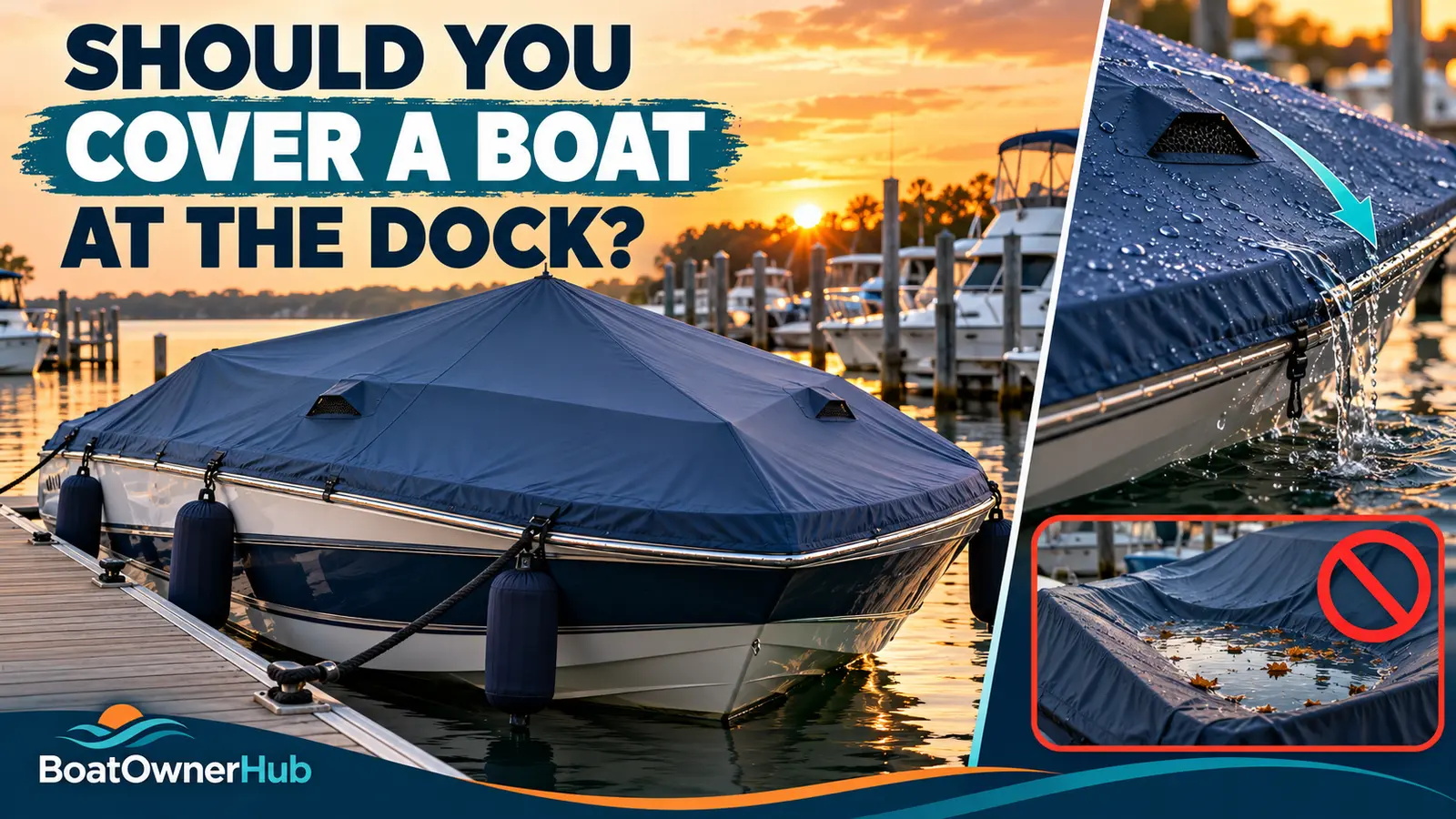
Editorial composite showing a generic mooring-cover setup. It is not a specific cover product or installation diagram.
Should you use a boat cover while docked? Usually yes, if the cover is designed and fitted for a moored boat, the interior is dry, air can move through the intended vents, rain can drain without pooling, and dock lines, fenders and inspection points remain accessible. A badly fitted or unsupported cover can make the situation worse by trapping moisture, chafing finishes, collecting water or adding wind load. The cover label and manufacturer instructions decide whether a particular cover is suitable for in-water storage.
Quick answer: cover it only when five conditions are met
- Right use: the maker identifies the cover for mooring, storage or in-water use.
- Dry interior: cushions, lockers and deck surfaces are dry enough for storage.
- Airflow: the designed vents are open and unobstructed.
- Drainage: the cover has continuous slope and the approved supports prevent low spots.
- Dock access: lines, fenders, cleats, bilge checks and shore-power connections remain inspectable.
If one of those conditions is missing, correct it before leaving the boat unattended.
Choose a cover by use, not only by size
| Cover type | What it covers | Dockside question to resolve |
|---|---|---|
| Mooring cover | Usually the cockpit, playpen or much of the open interior | Does the maker approve the attachment and support method for the boat while afloat? |
| Cockpit or bow cover | Selected open areas, often with snaps | Are all sections protected and can water drain between separate covers? |
| Full storage cover | Most or all of the boat above the waterline | Is it intended for wet-slip use, and how is it secured without trailer straps? |
| Trailerable cover | A fitted cover secured for road travel | Do not assume its trailering tie-down system is the correct dockside system. |
| Bimini top | Shade over part of the deck | A Bimini is not automatically a storage cover and may need to be stowed for wind. |
A well-matched in-water boat cover protects the areas that actually need protection and uses attachment points that work at the dock. Check the cover's stated use, boat style, centerline length, beam, windshield, rails, towers, outboard position and support instructions before buying or reusing one.
When covering a boat at the dock helps
- Sun exposure: a suitable opaque cover limits direct exposure on upholstery, flooring, consoles and stored equipment.
- Rain and debris: it keeps most water, leaves, bird droppings and airborne dirt out of open seating and storage areas.
- Turnaround time: a clean, dry interior can require less cleanup before the next trip.
- Privacy: a fitted cover reduces casual visibility of loose gear, although it is not a security system.
The cover is one layer of care, not a substitute for working drains, pumps, batteries, dock lines or regular inspection. Use the boat maintenance checklist to keep those systems in the same routine.
When a cover can make dockside conditions worse
Covering a boat while docked becomes a problem when the cover is wet, flat, loose or sealed. Watch for these failure modes:
- Trapped moisture: wet cushions, carpet, lockers or bilge areas can keep humidity high beneath the cover.
- Water pooling: a low spot adds weight, stretches fabric and can redirect water into openings.
- Chafe: loose fabric and straps can move against gelcoat, rails, windshields and upholstery.
- Wind load: an oversized or poorly secured cover can billow and load attachment points.
- Blocked access: a cover that hides cleats, lines, fenders, drains or shore-power connections makes inspection harder.
- Wrong support: improvised poles can slip or concentrate load on glass, seats or the cover.
Six steps for covering a boat at the dock
- Read the label and instructions. Confirm intended use, compatible attachment points, supports, vents and wind limitations.
- Clean and dry the interior. Remove wet towels, life jackets and trash. Open lockers to dry when practical and clear drains.
- Set dock lines and fenders first. Confirm tide or water-level range, line leads, chafe protection and fender position before the cover limits access.
- Install the approved supports. Create a continuous crown or ridge so water runs off instead of collecting.
- Secure and vent evenly. Fasten all required points, keep the cover off sharp edges and leave the intended vents unobstructed.
- Perform a walkaround. Check cleats, shore power, bilge access, outboard clearance, cover tension and every potential low spot.
Ventilation and support solve different problems
Vents help moisture and heat escape. Supports create shape so rain drains away. One does not replace the other. Taylor Made lists a sewn-in air vent as part of its BoatGuard Eclipse cover system, while Carver's support-pole guidance pairs a vented pole option with a support system intended to reduce pooling. Westland likewise describes vented support poles as a way to support the cover while providing airflow.
Use the cover maker's placement and adjustment instructions. Carver's Y-strap instructions, for example, call for even tightening and padding where webbing might chafe vinyl. Its installation guide also warns against allowing water or snow to stand on the cover. Those details matter more than adding random tension until the fabric looks tight.
Keep the dock system visible and serviceable
A boat cover at dock should not turn routine checks into guesswork. Leave safe access to:
- bow, stern and spring lines;
- fenders and their attachment points;
- shore-power inlet, cord and pedestal where used;
- bilge-pump discharge and high-water indicators;
- cockpit drains and scuppers;
- outboard, sterndrive or swim-platform clearance;
- registration and marina-required identification.
If a strap must cross a dock line or power cord, the setup needs to be changed. Lines and cables should move as intended without sawing against the cover or trapping a strap.
Match the setup to how long the boat will sit
Between frequent trips
- Dry obvious wet areas
- Use the fitted cover and normal supports
- Check the forecast and line setup
- Inspect after significant rain or wind
Long unattended period
- Use the storage procedure in the boat and equipment manuals
- Arrange reliable inspections
- Confirm pump and battery strategy
- Consider whether a wet slip is still the right storage location
For longer layups, compare the dock with indoor, covered, dry-stack and home options in Where to Store a Boat. Freezing temperatures or long inactivity also require the system-by-system work in the winterization guide; a cover alone does not winterize an engine, fuel system, battery or plumbing.
What to inspect after wind or rain
- Look for pooling, sagging or a shifted support.
- Check every attachment for loosening, chafe or tearing.
- Verify dock lines and fenders are still correctly positioned.
- Lift or open the cover as directed and check for trapped moisture, leaks and odors.
- Confirm cockpit drains, scuppers and bilge-pump discharge are clear.
- Dry the interior and reset the cover before leaving.
If dirty or oily water has collected below, follow the containment-first steps in the boat bilge cleaning guide. Do not pump contaminated bilge water overboard.
Why this guide does not recommend one universal cover
BoatOwnerHub currently has published reviews for two pontoon-cover sizes, but neither is presented here as a universal mooring solution. Cover suitability depends on the exact boat, attachment method, storage environment and the manufacturer's stated use. This guide therefore keeps the decision at the fit-and-instructions level instead of forcing a product into the wrong intent. Browse the Covers & Storage hub for related preparation guides.
Need a larger universal-style cover? Read the HAHASOLE 20-22 ft boat cover review for measurement, support and trailering limits.
Frequently asked questions
Should you cover a boat while it is in the water?
Usually yes when the cover is designed and fitted for moored or in-water storage, the interior is dry, ventilation is maintained and the cover can shed rain without pooling. Do not assume a trailer or storage cover is suitable at the dock; follow its instructions.
Can you cover a boat when it is wet?
Remove standing water and dry wet cushions, carpet, lockers and bilge areas as far as practical before covering. If weather forces a temporary cover, restore airflow and inspect the boat promptly rather than leaving moisture sealed inside.
How do you stop water from pooling on a boat cover?
Use the support system specified for the cover, create continuous drainage slopes, tension all attachment points evenly and recheck the setup after rain or wind. Do not improvise a pole that can damage upholstery, glass or the cover.
Should a docked boat cover be airtight?
No. The cover should protect the interior while allowing the airflow intended by the cover maker. An airtight setup can trap heat and moisture; use built-in vents or the approved vented support arrangement.
Can you leave a Bimini top up at the dock?
Use the Bimini manufacturer's storage and wind guidance. A Bimini is a shade top, not automatically a storage cover, and leaving it deployed can add wind load. Stow it when the instructions or forecast call for it.
How often should you check a covered boat at the dock?
Check it on a schedule suited to the weather, marina exposure and cover instructions, and inspect promptly after strong wind or heavy rain. Look for pooling, loose attachments, chafe, blocked drains, shifted dock lines and trapped moisture.
Sources and methodology
- Carver: Boat Cover Support System instructions
- Carver: Boat cover installation guidance
- Taylor Made: BoatGuard Eclipse cover features
- Westland: Mooring-cover fit, ventilation and support guidance
- West Marine: Boat-cover materials, fit and support overview
Manufacturer and retailer guidance checked October 18, 2026. General recommendations do not override the instructions for your boat, cover, Bimini, shore-power system or marina.