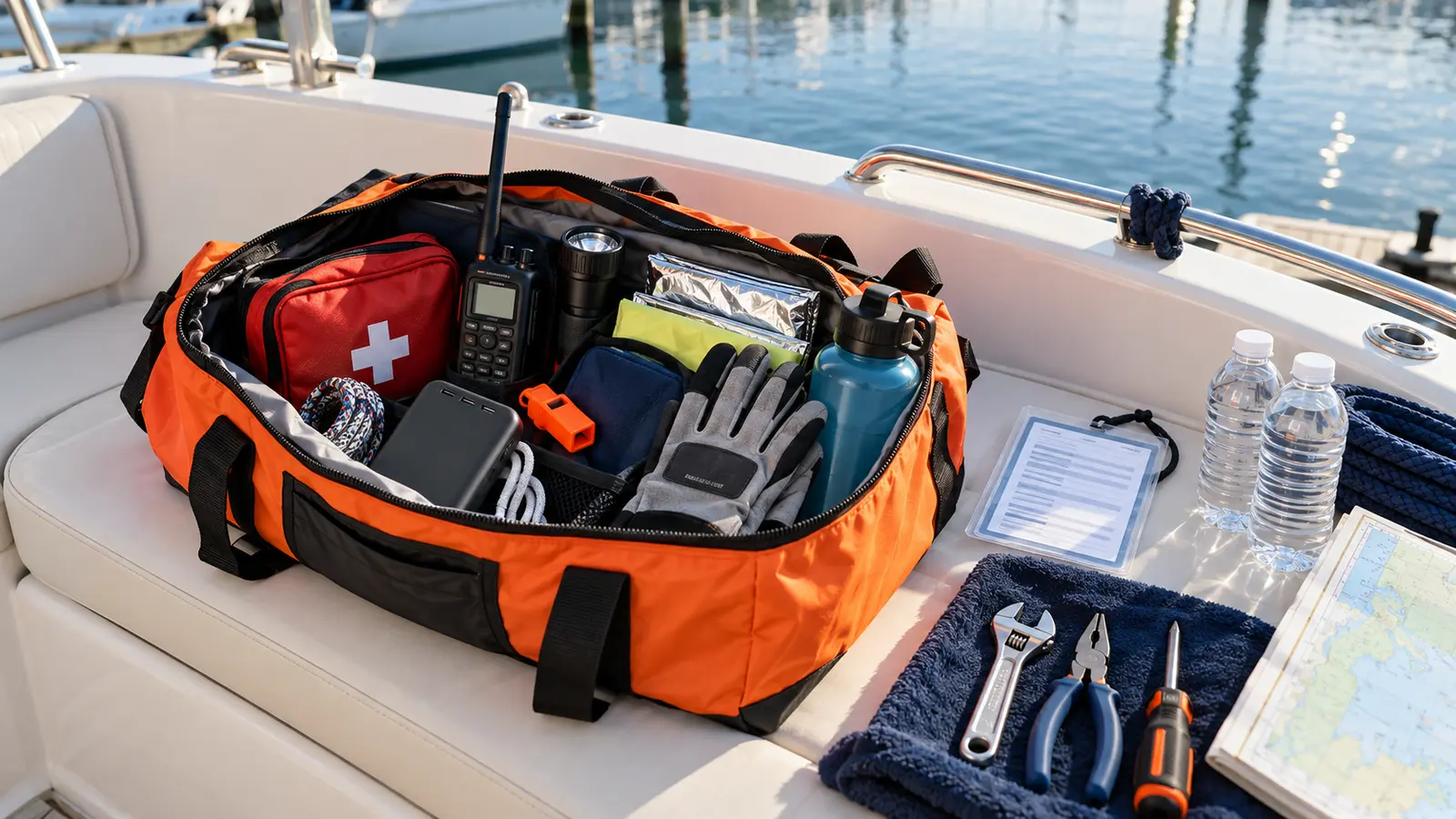
Editorial image of generic emergency-preparation supplies. It does not show a certified kit or a complete legal equipment set.
A practical boat emergency kit should help the crew call for assistance, treat a minor injury while professional help is arranged, remain visible, stay warm and hydrated, navigate if a primary device fails, and slow manageable water or equipment problems. Start with the required equipment for your boat and waters, then add a supplemental kit matched to the route, crew, water temperature and realistic rescue time. Store it where it can be reached in seconds, not under the gear you hope to protect.
Quick answer: build the kit in seven modules
- Distress communications: a marine VHF radio appropriate for the operating area, plus a charged phone as a backup.
- Position and navigation: a known position source, chart or map, compass and written trip information.
- First aid and personal needs: a crew-sized first-aid kit, essential personal medications and emergency contacts.
- Light and signaling: legal visual distress signals where required, plus accessible lights and sound signaling.
- Exposure and water: drinking water, sun protection, thermal protection and dry layers for the conditions.
- Damage control and tools: only the plugs, fasteners, hand tools and bailing equipment that fit the boat and can be used safely.
- Documents and power: waterproof copies of key information, charging cables and a maintained backup power source.
Use the separate boat safety equipment checklist to determine which required items apply before adding supplemental emergency supplies.
Required safety equipment and an emergency kit are not the same
The legal set depends on vessel length, propulsion, design, location and use. It can include approved wearable life jackets, a throwable device on many boats 16 feet and longer, visual distress signals in specified waters, fire extinguishers, navigation lights, sound-producing devices and an engine cut-off switch link when applicable. Labels, condition, expiration and accessibility matter.
An emergency kit for a boat adds supplies for credible problems after the required gear is already aboard. A first-aid pouch does not replace a life jacket. A flashlight does not automatically satisfy a visual-distress-signal rule. A phone does not replace appropriate marine distress communications. Keep the categories separate so a convenient bag does not hide a compliance gap.
| Category | Primary purpose | How to verify it |
|---|---|---|
| Required carriage equipment | Meet federal and applicable state or local rules | Use current official requirements, product approval labels and a vessel safety check |
| Supplemental emergency kit | Support communications, first aid, exposure protection, backup navigation and limited damage control | Match it to the route, crew, season, water temperature and rescue time |
| Personal equipment | Keep critical items with an individual if the crew is separated from the boat | Check fit, attachment, accessibility and manufacturer instructions |
| Trip information ashore | Help a responsible person start a timely response if the boat is overdue | File and close a float plan for each outing |
Pack for failure modes, not for a generic shopping list
Walk through what would happen if the engine stopped, the primary navigation display went dark, someone was injured, fog reduced visibility, the crew became wet and cold, or a fitting began to leak. Pack an answer only when it is safe and realistic for the crew to use. This keeps the boating emergency kit focused and prevents heavy, unfamiliar or hazardous gear from displacing essentials.
- Can we call and give our position? Communications and location come first.
- Can we remain afloat and visible? Life jackets, required signals and reachable lights must not be buried in the bag.
- Can we protect the crew while waiting? Plan for water temperature, wind, rain, sun and known medical needs.
- Can we slow a small problem without creating a larger one? Carry only boat-specific tools and damage-control items the crew understands.
- Will rescuers know we are overdue? Leave a float plan ashore, including the boat, route, people and communication equipment.
1. Distress communications and position
The Coast Guard describes VHF marine radio as the most common way to send distress alerts and communicate with other boats. Channel 16 is the primary VHF-FM calling and distress channel. A phone is useful as an additional layer, but cellular coverage offshore can be limited and a phone call does not alert nearby mariners the way a marine radio call can.
Choose communications for the actual route. A handheld VHF can be useful on an open or small boat if its range, power, charging and water-resistance specifications fit. A properly installed fixed-mount VHF can provide more power and may support Digital Selective Calling when configured correctly. Offshore or remote trips can justify a registered 406 MHz EPIRB or PLB and other equipment well beyond a near-shore day bag. Learn the distress procedure before an emergency, and keep the vessel identity and position format where the operator can find them.
- Marine VHF radio appropriate for the boat and operating area
- Charged phone in protective storage as a backup, not the only plan
- Current charging cable and maintained power bank
- GPS position source plus a paper chart or suitable map and a compass
- Written vessel description, registration information and emergency contacts
- Registered beacon for trips where the risk assessment supports it
NOAA states that U.S. beacon registration is free, and the information can help search-and-rescue authorities after activation. Follow the beacon maker's registration, testing, battery and mounting instructions. Never test a beacon by transmitting a distress alert.
2. First aid, medications and crew information
Size the first-aid kit for the number of people, trip length and activities. The useful kit is one the crew can open quickly, understand and restock. Include protective gloves, dressings, bandages, antiseptic supplies and any other items recommended by a qualified course or medical professional for the planned use. Take first-aid and CPR training rather than relying on packaging instructions during a crisis.
Each person should manage essential prescription medications with the prescriber's guidance. Keep allergies, medical conditions, emergency contacts and medication information current and protected from casual disclosure. Add motion-sickness or other over-the-counter products only after checking suitability, dosing, interactions and expiration with a clinician or pharmacist when needed.
3. Signaling, light and sound
Required visual distress signals depend on the waters and vessel. The Coast Guard guide notes that approved pyrotechnic signals must be serviceable, unexpired and readily accessible when they are used to meet the requirement. It also explains that approved non-pyrotechnic devices have specific markings and day or night uses. Read the label, know the operating limits and never assume that a general flashlight or novelty strobe counts as an approved signal.
- Required, in-date day and night visual distress signals for the operating area
- Water-resistant flashlights or headlamps with maintained batteries
- Whistles attached to life jackets when suitable, plus the required sound-producing device
- Bright cloth, mirror or other backup attention aids only as supplements
- Navigation-light spares or a documented backup plan that fits the boat
Store pyrotechnic signals exactly as their labels and official guidance direct. Keep them away from children, ignition sources and incompatible supplies. A marked, cool, dry and readily accessible container may be appropriate, but local disposal rules and the product instructions control.
4. Water, warmth and weather protection
Pack drinking water based on crew, climate and trip duration, then add a reserve. Food is lower priority on a short trip than communications, flotation, water and exposure protection, but shelf-stable snacks can help on a delayed return. Replace any container that leaks or has passed its marked date.
Cold water changes the plan even when the air feels warm. The National Weather Service recommends dressing for the water temperature, wearing a life jacket and carrying appropriate communications such as VHF, PLB or EPIRB. Add dry layers, thermal blankets, rain protection, hats, sunscreen and gloves for the expected conditions. For truly cold or offshore water, specialized immersion protection and training may be necessary. A foil blanket in a bag is not equivalent to a dry suit or immersion suit.
Check the marine forecast and water temperature before leaving. If thunderstorms, fog, wind or cold exceed the boat or crew's limits, the correct emergency preparation is to postpone the trip.
5. Damage control, bailing and basic tools
Carry tools that fit the fasteners, battery terminals, hose clamps and access panels on the boat. Add a manual bailing device where appropriate, a knife or line cutter stored safely, spare fuses of the correct type, marine-rated tape or sealing material for limited temporary use, and softwood plugs sized for through-hull fittings if the boat design calls for them.
Damage-control supplies buy time; they do not make a damaged boat safe. Call for help early, put life jackets on, control ignition sources and move people away from the hazard. Do not enter a flooding, fuel-contaminated or poorly ventilated compartment. Do not improvise wiring protection, bypass a fuse or use a repair that prevents a seacock or emergency device from operating.
The common boat maintenance problems guide provides stop conditions for no-start, overheating, fuel odor, rising water, steering faults and severe vibration. Use the boat maintenance checklist before departure so the emergency kit does not become the maintenance plan.
6. Documents, contacts and backup power
- Waterproof copies of registration and insurance information when carried copies are appropriate
- Boat make, model, color, identifying numbers and a current photo
- Emergency contacts and relevant marina, towing or local authority information
- Known medical information for the crew, stored with appropriate privacy
- A written radio distress prompt and coordinates format
- Charging cables, protected spare cells where the device permits them and a maintained power bank
Keep originals where the law requires them and do not put the only copy of every document in one bag. A float plan belongs with a responsible person ashore. The Coast Guard guide says it should tell someone where you are going and when you will return; the official Float Plan Central form can also record passengers, communication equipment and waypoints.
7. Add equipment for the actual trip
| Trip profile | Extra planning emphasis | Question to answer before launch |
|---|---|---|
| Sheltered inland day trip | Weather, local contacts, first aid, phone backup, light, water and a clear float plan | How quickly can reliable help reach this part of the water? |
| Night operation | Required navigation lights, night signals, spare lighting and lower-temperature exposure gear | Can every critical item be found without emptying the bag? |
| Cold water | Wearable flotation, water-temperature clothing, fast communications and trained recovery | Is the crew dressed for immersion, not just the air temperature? |
| Coastal or Great Lakes | Applicable visual distress signals, VHF, position reporting, weather monitoring and more reserve | What changes if cell coverage disappears? |
| Offshore or remote | Registered beacon, redundant communications and navigation, life-raft and immersion-suit assessment, professional equipment selection | How long could rescue take after the primary systems fail? |
How to store a boating emergency kit
Use labeled modules so one person can retrieve first aid, communications or exposure gear without dumping everything onto the deck. Put the most urgent items at the top or in external pockets. Secure the main bag so it does not become a projectile, but make the release obvious. Do not bury it below coolers, tackle, seat cushions or luggage.
Some items may need different storage. Wearable life jackets must remain readily accessible, and throwable devices must be immediately available. Pyrotechnic signals have their own storage instructions. A beacon may need to be mounted or carried on the person. A VHF clipped to the operator can remain available if a fire or capsize blocks the bag.

HEETA 5L Dry Bag
Useful for: Organizing a phone, copies of documents, charging cable and other small backup items inside a larger emergency plan.
Check first: Five liters is limited capacity, and the product is not intended for underwater storage. It is not approved safety equipment and should not hold the only critical communication device if the bag may be inaccessible.
Read the complete reviewInspection schedule that keeps the kit usable
| When | Check |
|---|---|
| Before every trip | Presence, accessibility, radio and phone charge, current weather, crew medications, water, route and float plan |
| After any use or wet exposure | Replace used items, dry the bag and contents, inspect corrosion and recharge equipment |
| Regularly during the season | Test electronics by the manual, rotate batteries or power banks, inspect seals and update contacts |
| Start and end of season | Complete inventory, expiration review, water-temperature plan, clothing sizes, vessel changes and crew training |
| After changing the boat or route | Reassess tools, plugs, communications, required equipment, storage and likely rescue time |
Write inspection dates on a checklist, not on memory. Do not activate distress equipment during an ordinary test. Use the self-test or maintenance process in the manufacturer instructions, and record battery replacement or service dates.
Boat emergency kit checklist
Carry and verify
- All required federal, state and local safety equipment
- Properly fitted life jackets for every person, worn as conditions and law require
- Appropriate distress communications and a reliable way to report position
- First-aid kit and essential personal medications
- Required visual distress signals plus supplemental lighting and sound
- Drinking water and condition-appropriate exposure protection
- Boat-specific tools, bailing and limited damage-control supplies
- Backup navigation, critical information and maintained power
Complete ashore
- Give a responsible person a float plan with departure, route, return time, people and boat description
- Tell that person when and how to escalate if you are overdue
- Close the plan promptly after returning
- Check the official marine forecast, water temperature and local notices
If fishing is part of the trip, the boat fishing essentials checklist adds licenses, tackle, fish care and deck organization without replacing this safety plan. Use the battery runtime calculator only for rough planning, not as proof that emergency electronics will last through a rescue.
Common emergency-kit mistakes
- Buying a sealed bundle and never opening it: Inspect every item, remove inappropriate contents and add crew-specific needs.
- Treating the bag as legal compliance: Check official carriage requirements separately.
- Using a phone as the only communication: Coverage and location reporting can fail on the water.
- Burying the kit: A bag under heavy gear is not emergency equipment.
- Keeping every critical item together: Fire or capsize can separate the crew from the main bag.
- Ignoring expiration and batteries: Signals, medications, food, water containers and electronics all have maintenance limits.
- Packing unfamiliar repair gear: In an emergency, training and a timely distress call matter more than a complicated tool.
- Forgetting the float plan: The best onboard kit cannot alert someone ashore that the boat is overdue.
Boat emergency kit questions
What should be in a boat emergency kit?
Start with reliable distress communications, a first-aid kit sized for the crew, lights and backup signaling, drinking water, exposure protection, essential medications, navigation backups, power, basic tools, damage-control items and copies of critical information. Adjust the kit for the boat, route, water temperature, weather, passengers and expected rescue time.
Is a boat emergency kit the same as required safety equipment?
No. Federal and state carriage requirements can include approved life jackets, visual distress signals, fire extinguishers, sound devices and other equipment based on the vessel and operating area. A supplemental emergency kit adds useful communications, medical, exposure, repair and survival supplies but does not replace required equipment.
Where should a boat emergency kit be stored?
Store it where an adult can reach it quickly without moving heavy gear, opening a locked compartment or entering a hazardous machinery space. Keep critical communications and personal safety items on the person or in a second immediately accessible module when capsize, fire or flooding could separate the crew from the main bag.
Is a dry bag enough for a boat emergency kit?
A dry bag can organize and protect selected supplies from spray, but it is not a complete emergency system. Capacity, closure, attachment, buoyancy and underwater-use limits must match the intended use, and required safety equipment still needs its own compliant and accessible stowage.
How often should a boat emergency kit be checked?
Do a quick check before every trip and a complete inventory at the start of the season and at regular intervals during use. Replace expired, used, wet, corroded, damaged or depleted items immediately, test electronics by their manuals and update documents, crew information, medications and trip-specific supplies.
Sources and editorial method
BoatOwner Hub checked the legal boundary, communications, distress-signaling, cold-water and float-plan guidance against current official sources on October 14, 2026. This article is an editorial planning guide, not a substitute for regulations, equipment labels, manufacturer manuals, safety training or professional advice.
- U.S. Coast Guard: A Boater's Guide to Federal Requirements
- U.S. Coast Guard Navigation Center: Maritime Telecommunications
- National Weather Service: Safe Boating During Changing Weather
- National Weather Service: Cold Water Hazards and Safety
- NOAA: U.S. 406 MHz Beacon Registration
- U.S. Coast Guard Auxiliary: Float Plan Central
- U.S. Coast Guard: Boating Safety Mobile App