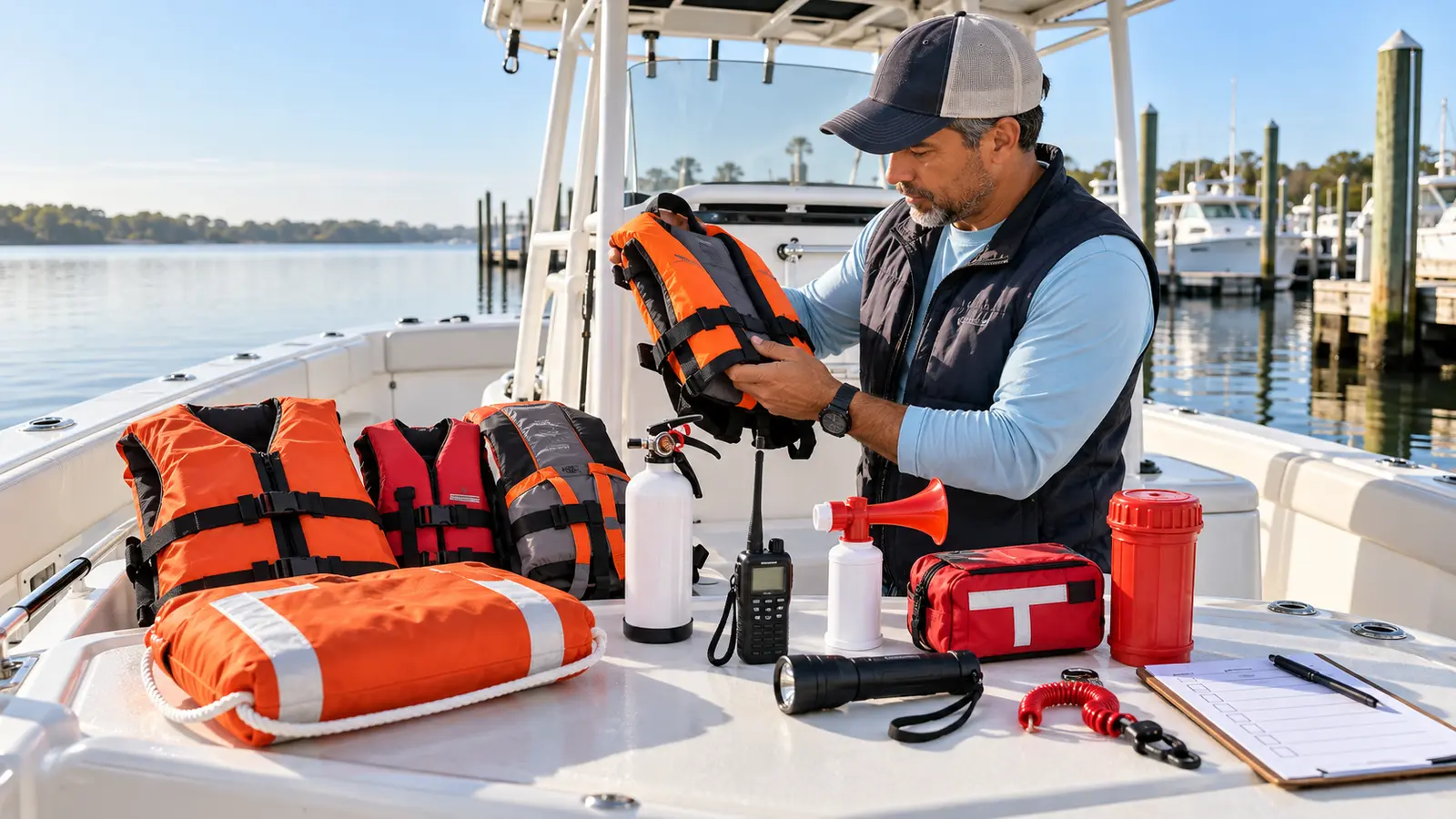
Editorial image of generic safety equipment. It is not a complete legal equipment set and does not show product certification labels.
Boat safety equipment is not one universal shopping list. Start with an approved, properly sized wearable life jacket for every person aboard. Then add the equipment triggered by the boat's length, propulsion, construction, age, activity and operating waters. Before every trip, confirm that each required item is aboard, serviceable, within any applicable service life, correctly mounted or stowed and reachable without unloading the boat.
Quick answer: the safety equipment check has five parts
- Identify the boat: record length, propulsion, fuel arrangement, build date and any enclosed spaces.
- Identify the trip: note the waterway, distance from shore, daylight or night operation, activity and passengers.
- Build the legal baseline: use current federal rules, then the state and local rules for the water.
- Verify each item: check approval label, size, count, condition, expiration or service date and accessibility.
- Add trip-specific backup: communications, first aid, exposure protection and a float plan belong on top of the legal minimum, not instead of it.
Which equipment applies to your boat?
Use this table to find the questions that change the list. It deliberately separates universal starting points from condition-dependent requirements.
| Boat or trip factor | Equipment question it triggers | What to verify |
|---|---|---|
| Every recreational vessel | Wearable life jacket for each person | Coast Guard approval, correct size, serviceable condition and ready access |
| Boat 16 feet or longer | Throwable flotation device, with exceptions such as canoes and kayaks | Approved device, serviceable condition and immediate access |
| Motorized boat | Fire protection, ventilation, backfire flame control and engine cut-off rules can apply | Boat construction, fuel arrangement, engine type, build date and current rule |
| Coastal waters, Great Lakes, territorial seas or connected waters covered by the rule | Visual distress signals | Approved combination, day and night coverage, quantity, expiration and exemptions |
| Operation from sunset to sunrise or in restricted visibility | Navigation lights | Correct configuration, visibility, operation and unobstructed arcs |
| All operating areas | Sound-producing device | Device type and audibility appropriate for vessel length |
| PWC, towing sports, children or special activities | Wear requirements and activity-specific equipment | Federal baseline, state rules and product suitability for the activity |
1. Life jackets and throwable flotation
The first item on any safety equipment for boats checklist is a wearable life jacket for every person aboard. The device must be Coast Guard approved, in good and serviceable condition and the correct size for the intended wearer. A device buried under a seat full of luggage is not ready access. Inflatable models also require the correct cylinder, inflator status and maintenance under the maker's instructions.
Federal rules generally require children under 13 to wear an appropriate life jacket while the vessel is underway unless they are below deck or in an enclosed cabin. State age thresholds and activity rules can differ. Personal watercraft and towing sports often have additional wear and device-type requirements. Check the current rule for the state and activity instead of relying on a label such as "universal boating vest."
Most recreational boats 16 feet or longer must also carry an approved throwable device that can be reached immediately, not strapped under other gear. The Coast Guard FAQ explains important exceptions, including canoes and kayaks. Review the current Coast Guard life-jacket guidance, then make the crew wear the right device for cold water, rough conditions, nighttime operation and limited swimming ability rather than treating carriage as the finish line.
2. Visual distress signals
Federal visual distress signal carriage rules generally apply to recreational boats used on coastal waters, the Great Lakes, territorial seas and waters directly connected to them up to the regulatory boundary. The required day and night combination, exemptions and acceptable devices depend on the vessel and operation. Inland lakes can have different state or local requirements.
Check every signal for Coast Guard approval, intended day or night use, quantity, condition and expiration. Pyrotechnic signals require dry storage, careful handling and lawful disposal. An approved electronic visual distress signal can be part of a compliant setup only when the device and the rest of the combination satisfy the current rule. A phone flashlight, unapproved strobe or ordinary orange flag should not be assumed to replace an approved signal.
If the boat has a gasoline inboard or sterndrive engine, add the engine-compartment blower check to the pre-start routine.
3. Fire extinguishers and fuel-vapor protection
Not every small motorboat has the same extinguisher requirement. The Coast Guard's recreational-boater fire extinguisher FAQ says a boat under 26 feet with an outboard engine, fuel in a portable tank and no spaces where vapors can be trapped may be exempt. Built-in tanks, closed compartments, permanently installed engines and other construction features can trigger the requirement.
When an extinguisher is required, confirm the approved type and number for the boat, then check its age and serviceability. It should be readily accessible, not hidden behind a packed locker. The gauge or indicator must be in the operable range when present, the pin must be secure, the nozzle clear and the body free of significant damage or corrosion. Older extinguishers can be subject to the 12-year rule described by the Coast Guard.
Gasoline-powered boats can also need compliant ventilation and backfire flame control. Do not treat a portable extinguisher as permission to ignore a fuel smell, damaged line, leaking tank or failed blower. Stop, eliminate ignition sources, ventilate only as the boat and engine manuals direct and use a qualified marine technician when the source is not immediately and safely resolved.
4. Navigation lights and sound-producing devices
Navigation lights are not decorative accessories. The required arrangement depends on vessel type, length and operating status. Inspect lenses, wiring, switches, mounts and visibility from the waterline. Gear, canvas, antennas and passengers can block a light that still illuminates at the switch. Test the full configuration before any trip that could continue after sunset or encounter restricted visibility.
A sound-producing device is also part of the federal baseline. The type and performance requirement change with vessel length. A whistle that works in a quiet driveway may be difficult to hear over wind and engines, so verify the current requirement and keep the device reachable from the helm. Learn the navigation sound signals rather than carrying a horn with no plan to use it.
5. Engine cut-off switch link
The federal operator-use rule applies to covered recreational vessels, generally motorboats under 26 feet with three or more horsepower, when operating on plane or above displacement speed. The operator must use the engine cut-off switch link when the rule applies. The Coast Guard's engine cut-off device guidance explains covered vessels, operating conditions and exceptions.
Inspect the lanyard, clip, wireless fob, battery and switch under the boat and device manuals. Test at idle in a safe setting where an unexpected shutdown cannot create a collision or loss of control. A spare link can be useful only if it is the correct part and the crew understands how to stop and restart the engine safely.
Approval is not enough: verify condition and access
Many compliance failures happen after the right item was purchased. A faded approval label, child wearing an adult vest, expired flare, discharged extinguisher, corroded light, dead horn or buried throwable can turn an apparently complete kit into an unusable one.
| Check | Question to ask | Stop condition |
|---|---|---|
| Approval | Is this exact device approved for the intended carriage or activity? | Missing, unreadable or incompatible approval information |
| Fit and count | Is there the correct size and quantity for the actual crew? | Borrowed, missing or badly fitted equipment |
| Condition | Are fabric, straps, cylinders, pins, nozzles, cases, lenses and wiring serviceable? | Damage, corrosion, discharge, contamination or unauthorized repair |
| Service life | Is the expiration, battery, inspection or maintenance date current? | Expired signal, overdue service or uncertain battery condition |
| Access | Can a crew member reach and use it in seconds? | Locked, buried, strapped down or blocked by optional gear |
| Crew knowledge | Does the crew know where it is and how to use it? | No briefing or unfamiliar operating steps |
What to add beyond the minimum
The legal list is the floor. A good boating safety equipment plan also covers communications, position, first aid, weather, exposure, anchoring and a float plan. The correct additions change between a protected inland lake and an offshore route.
- A marine VHF radio appropriate for the operating area, with the crew able to make a distress call
- A charged phone as a backup where coverage exists, protected from spray
- A maintained first-aid kit plus essential personal medications
- Drinking water, sun protection and thermal protection for the forecast and water temperature
- An anchor and rode matched to the boat and bottom conditions
- A chart or suitable map, position source and compass
- A filed float plan with a reliable person ashore
- Boat-specific plugs, bailing equipment and tools that can be used without creating more risk
Use the separate boat emergency kit guide to organize those supplemental supplies. Anglers can also use the boat fishing essentials checklist, while the fishing clothing guide helps match layers, sun protection and footwear to the trip.
Optional small-boat backup: a compact paddle

Attwood 11826-1 Telescoping Paddle
This compact paddle can suit a small boat where reachable backup propulsion has a realistic job. The reviewed model extends to a listed 54 inches and stores shorter than a fixed paddle.
- Useful for: limited close-range maneuvering on a small, compatible boat.
- Verify: collapsed length, deployed reach, grip, blade condition and an accessible storage location.
- Limitation: it cannot guarantee progress against wind or current and is not practical primary propulsion for a large boat.
A 10-minute predeparture equipment check
- Count every person and match a serviceable wearable life jacket to each one.
- Confirm any required throwable device is immediately reachable.
- Check the fire extinguisher count, type, age, gauge, pin, nozzle and mount.
- Verify distress signals for day or night coverage, condition and expiration.
- Test navigation lights and the horn from the operating position.
- Inspect and attach the engine cut-off switch link when the rule applies.
- Turn on communications and confirm charging, channels and position display.
- Clear access to safety equipment, exits, controls and boarding areas.
- Brief the crew on life jackets, extinguisher, radio, throwable device and emergency stop.
- Check the weather, file the float plan and confirm the state or local requirements for the water.
A free Vessel Safety Check can help identify missing or unserviceable equipment. The Coast Guard federal guide describes the program as an educational review by trained volunteer examiners. It is not a substitute for the operator's ongoing responsibility, but it is a useful second set of eyes.
Common mistakes to avoid
- Buying a prepacked kit and assuming it is legal: the box cannot know your vessel length, waters, fuel system or passengers.
- Counting storage as accessibility: required equipment can be aboard and still unusable when buried.
- Ignoring state rules: child-wear ages, skier-down flags, education documents and activity rules can vary.
- Keeping expired signals as the compliant set: expired pyrotechnics may be carried as extras only when the required current set is also aboard and storage is safe.
- Using product category language as proof: "marine," "emergency" or "safety" in a listing is not an approval label.
- Blocking equipment with upgrades: coolers, covers, rod holders and storage bins must not hide lights, extinguishers, throwables, gates or controls.
Frequently asked questions
What safety equipment is required on a boat?
Federal minimums can include an approved wearable life jacket for each person, a throwable device on many boats 16 feet or longer, visual distress signals on specified waters, fire extinguishers on qualifying motorboats, sound-producing devices, navigation lights and an engine cut-off switch link when applicable. The exact list changes with vessel length, propulsion, design, use and operating area, and state rules can add requirements.
Do all boats need a fire extinguisher?
No. The requirement depends on propulsion and construction. For example, the Coast Guard says a motorboat under 26 feet with an outboard, a portable fuel tank and no spaces where fuel vapors can be trapped may be exempt. When an extinguisher is required, its type, count, age, condition and accessibility must comply with the current rules.
Do I need flares on an inland lake?
Not always. Federal visual distress signal carriage rules generally apply on coastal waters, the Great Lakes, territorial seas and waters directly connected to them up to the specified boundary. State or local rules and prudent trip planning can still call for signaling equipment on inland waters, so check the authority responsible for the lake.
Where should boat safety equipment be stored?
Store each item where it is readily accessible for its intended emergency. Life jackets, throwable devices, extinguishers, sound signals and engine cut-off links should not be buried under luggage, locked away or blocked by optional accessories. Follow the equipment maker's mounting and storage instructions.
How often should boat safety equipment be checked?
Do a reach-and-condition check before every trip and a complete inventory at the start of the season and at regular intervals during use. Replace expired, discharged, corroded, water-damaged, missing or unserviceable gear immediately and record battery or service dates where helpful.
Is an emergency kit the same as required boat safety equipment?
No. Required safety equipment is determined by law and the boat's characteristics. A supplemental emergency kit adds communications, first aid, exposure protection, backup power, documents and damage-control supplies, but it does not replace required approved equipment.
Authoritative sources
- U.S. Coast Guard: A Boater's Guide to the Federal Requirements for Recreational Boats
- U.S. Coast Guard: life-jacket wear and serviceability
- U.S. Coast Guard: fire extinguisher requirements FAQ
- U.S. Coast Guard: engine cut-off devices
- U.S. Coast Guard: federal and state boating regulations
Requirements and source pages checked October 16, 2026. Regulations and guidance can change. Verify the current official sources for the vessel and trip.