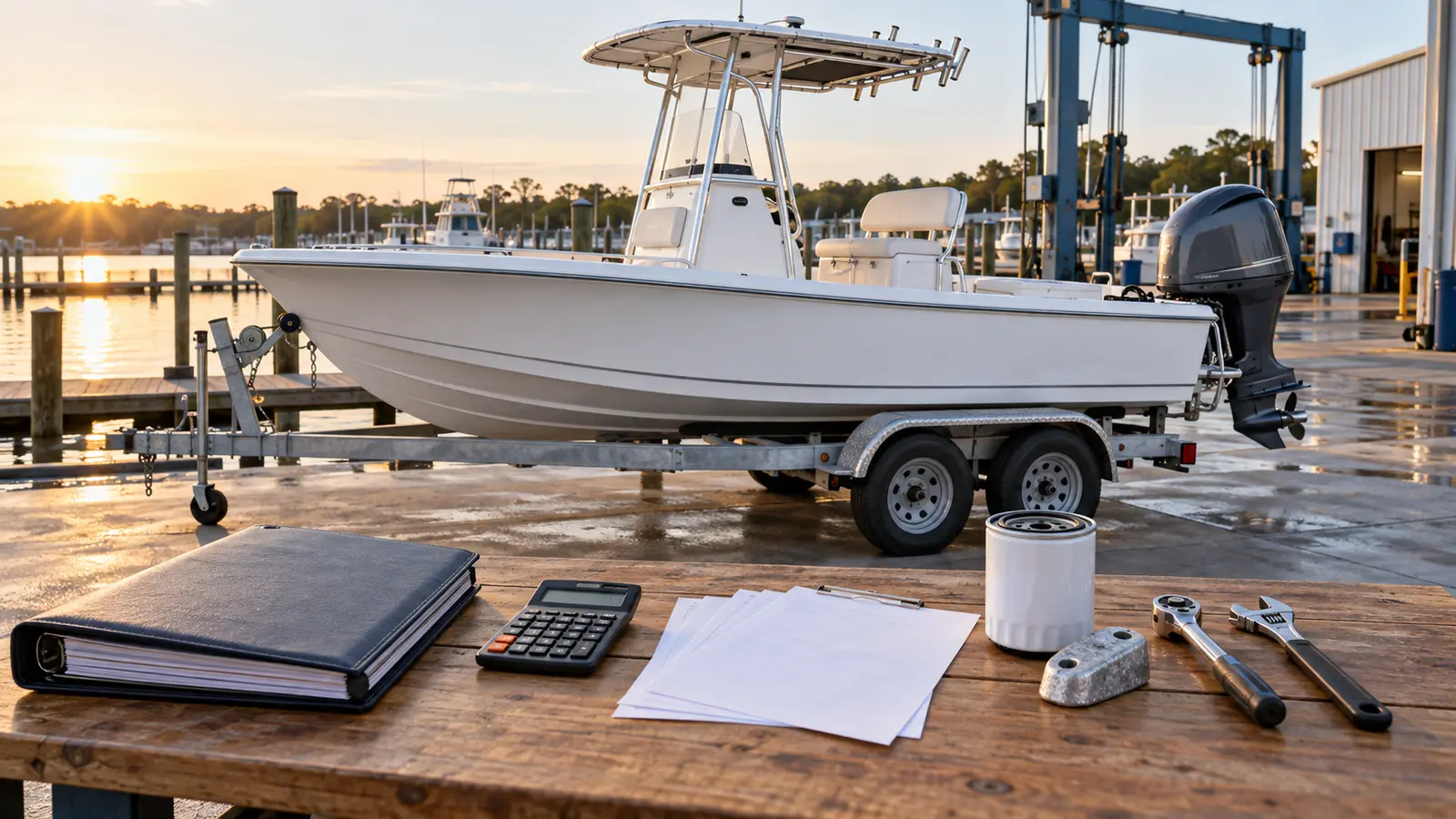
Ask five boat owners what maintenance costs and you may get five completely different numbers—all of them honest. One keeps a 19-foot outboard in the driveway and does basic service at home. Another pays for a slip, twin-engine service, winter haul-out and indoor storage. Their boats are not comparable, so their annual totals are not either.
Quick answer: What should you budget?
Do not start with a national average. Add the scheduled service due for your exact engine and boat, hull and systems care, trailer work, winterization and storage, then create a separate reserve for repairs. Divide that total by 12 and fund it monthly. The often-repeated “10% of boat value” rule is a rough warning, not a dependable estimate.
This article separates maintenance cost from the broader cost of owning a boat. That distinction matters: fuel, insurance, registration, financing and slip fees affect affordability, but they do not tell you what it costs to keep the machinery and structure in good condition.
Is boat maintenance really 10% of the boat’s value?
Discover Boating describes annual maintenance around 10% of the boat’s cost or less as a common rule of thumb. It is easy to remember, which is probably why it survives. But boat value and maintenance need are not tightly linked.
A nearly new $80,000 center-console with one engine may need much less than $8,000 in routine work during an uneventful year. A $10,000 older boat with a neglected sterndrive, tired upholstery and trailer problems can exceed $1,000 quickly. Purchase price also moves with the used-boat market while the cost of filters, yard labor and storage does not move in the same way.
Maintenance cost versus total boat ownership cost
| Usually part of maintenance | Usually tracked as another ownership cost |
|---|---|
| Engine oil, filters and gear lubricant | Fuel used on trips |
| Cooling-system, anode and corrosion care | Insurance |
| Hull, deck, canvas and upholstery care | Registration, taxes and permits |
| Battery, pump, hose and electrical upkeep | Loan payments and interest |
| Trailer tires, bearings, brakes and lights | Slip or mooring fee |
| Winterization and spring commissioning | Food, fishing gear and optional upgrades |
| Unexpected repair reserve | Depreciation |
Storage sits in the middle. It is technically an ownership cost, but in cold climates it is so closely tied to winterization and protection that many owners keep it in the same maintenance fund. The important thing is consistency: do not count it twice or forget it entirely.
Seven factors that change annual maintenance cost
1. Boat length and complexity
Length affects surface area, cover size, storage and haul-out. Complexity often matters even more. A simple open boat is cheaper to care for than a similar-length cabin boat with a head, water heater, refrigerator, air conditioning and generator.
2. Engine type and engine count
Every additional engine brings another set of oil, filters, spark plugs, anodes, gear lubricant and labor. Inboards, sterndrives and outboards have different cooling and drive-maintenance requirements. Follow the calendar and engine-hour schedule for the exact model.
3. New versus used condition
A new boat can have lower repair risk but still needs scheduled service. A well-kept used boat may be predictable; a neglected one may reveal deferred maintenance during the first year. A survey, engine inspection and service records help turn that uncertainty into a budget.
4. Freshwater versus saltwater
Saltwater usually adds cleaning, flushing where the manufacturer specifies it, corrosion prevention, anode attention and closer inspection of wiring, fasteners and metal components.
5. Annual engine hours
Some service is calendar-based, while other work is due by hours. Owners who use the boat heavily may reach an hour interval more than once in a year. Very low use is not maintenance-free: fuel, batteries, seals and corrosion can suffer during inactivity.
6. Storage and climate
Freezing regions can add haul-out, winterization, a cover or shrink-wrap and spring commissioning. Discover Boating gives broad seasonal reference ranges of $20–$50 per foot for outdoor storage and $50–$200 per foot for indoor storage, while emphasizing that location and boat size change the price.
7. DIY work versus paid labor
Doing approved low-risk work can reduce labor cost, but it still requires tools, fluids, disposal and time. A mistake involving fuel, cooling, electrical, steering or structural work can cost far more than the saved labor.
Build your annual budget in six buckets
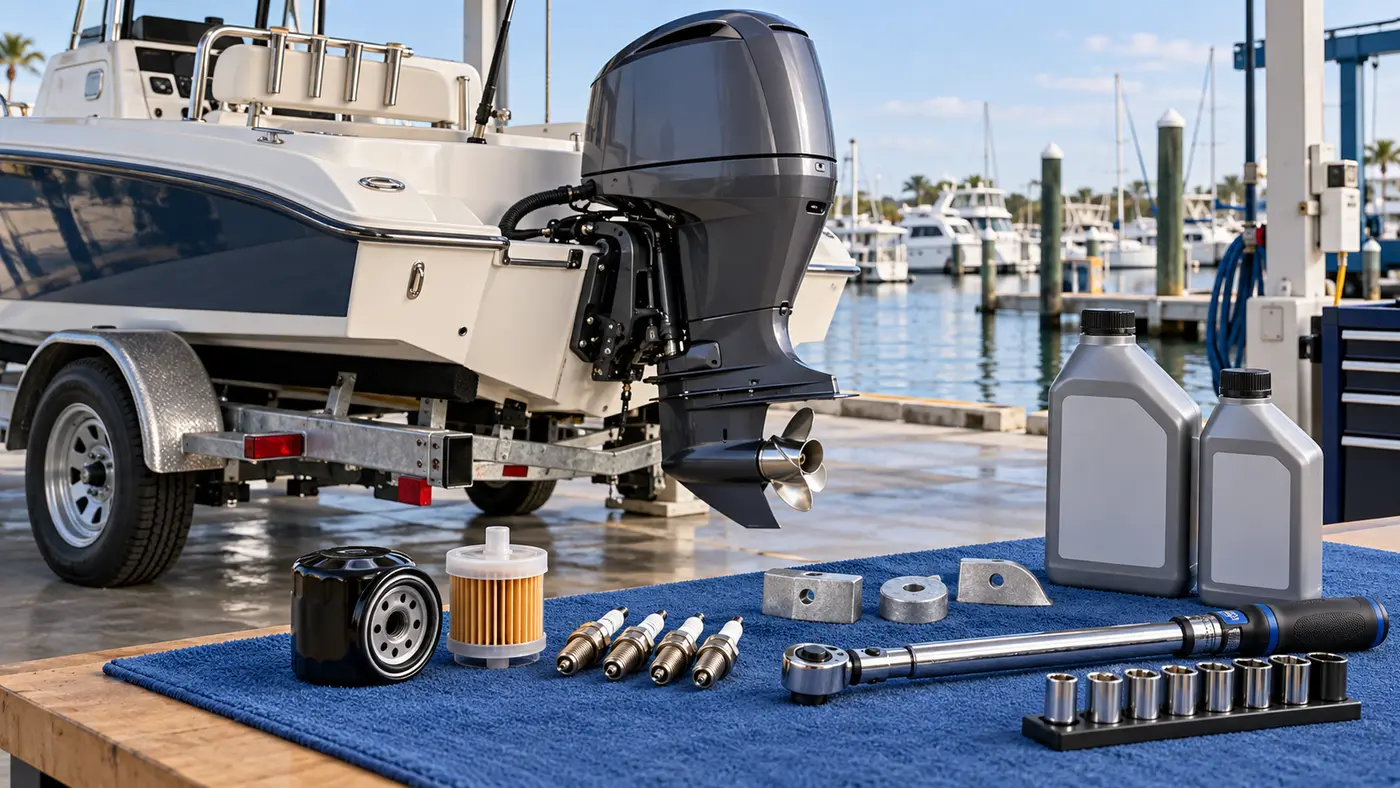
1. Scheduled engine and drive service
Read the service chart and write down every item due in the next 12 months by date or engine hours. Price parts and labor separately. Ask whether shop supplies, environmental fees, haul-out or mobile-service travel are included.
2. Hull, deck and onboard systems
Include cleaning and surface protection, sealant inspection, canvas repairs, pumps, hoses, sanitation equipment, electronics connections and required safety-equipment replacement. Do not turn optional upgrades into “maintenance” just because they happen at the same shop visit.
3. Battery and electrical care
Budget for testing, a compatible charger or maintainer when needed, terminal protection and eventual replacement. If a battery repeatedly goes flat, fund diagnosis rather than purchasing batteries on a cycle. See our battery troubleshooting guide.
4. Trailer service
Track tire age as well as tread, plus bearings, brakes, lights, coupler, winch, bunks or rollers and corrosion. A trailer may receive little mileage but still age outdoors and sit under load.
5. Winterization, storage and spring commissioning
Separate the service work from the storage space so quotes are easier to compare. List haul-out, pressure washing, blocking, cover or shrink-wrap, winterization of each system and spring recommissioning. Our complete winterization checklist helps identify the systems that need pricing.
6. Repair reserve
A reserve is not the same as scheduled maintenance. List plausible failures based on age and condition: a pump, battery, trailer tire set, canvas repair or electrical diagnosis. For older engines or major findings from a survey, create a longer-term capital-replacement fund as well.
Boat maintenance budget calculator
Enter your current quotes, last-year invoices or best planning estimates. Leave a category at zero only if it truly does not apply.
Three worked budget examples
These are examples of the method—not national averages, quotes or promises. Each owner would replace the figures with local prices.
| Illustrative setup | Annual plan | Why the total differs |
|---|---|---|
| 19-foot single-outboard boat, stored at home | $600 engine service + $250 hull/systems + $250 trailer + $700 reserve = $1,800 | No paid storage; simple systems; owner handles cleaning |
| 24-foot boat, outdoor winter storage | $900 service + $400 care + $350 trailer + $1,200 winter/storage + $1,500 reserve = $4,350 | Seasonal storage and professional winter work |
| 30-foot twin-engine boat with more systems | $2,500 engine work + $1,200 systems + $4,500 storage/winter + $1,200 yard work + $4,000 reserve = $13,400 | Two engines, haul-out, complex systems and larger repair exposure |
The examples are deliberately different. Using the same percentage for all three would hide the decisions that actually control cost.
How to get maintenance quotes you can actually compare
- Provide the boat year, make, model, engine model, engine count and engine hours.
- Send the relevant service schedule or ask the shop to identify the interval.
- Request an itemized scope: parts, fluids, labor, diagnostics, haul-out, travel, disposal, shop fees and tax.
- Ask which items are inspection-only and which are automatic replacement.
- Confirm what happens if the technician finds additional work.
- Ask when the work can be completed; peak-season delays can create storage or missed-use costs.
A cheaper quote may simply omit gearcase service, water-pump inspection, trailer work or spring commissioning. Scope matters more than the headline price.
How to reduce maintenance cost without neglecting the boat
- Prevent instead of postpone. Follow scheduled service and investigate leaks, heat, vibration and warning alarms early.
- Keep a log. Dates, engine hours, parts and next-due points prevent duplicate work and missed intervals.
- Clean and protect appropriately. Salt, moisture and UV exposure make small care tasks financially meaningful.
- Learn suitable DIY tasks. Cleaning, inspections and manual-approved basics may reduce labor while helping you notice changes.
- Combine planned yard work. When safe and practical, one haul-out can cover multiple inspections and services.
- Buy the boat you can store. A boat that fits at home or on an existing trailer may have a very different annual cost from one requiring a marina and haul-out.
- Avoid false economy. Automotive parts or household hardware may not be suitable for marine use. Use specified components.
Costs that should make a buyer pause
Before buying a used boat, ask about missing records, overdue engine service, soft decks, water intrusion, corrosion, old fuel, charging faults, trailer brakes and tires, damaged canvas and non-working electronics. One unresolved issue is not automatically a bad purchase; several can turn a “cheap” boat into an expensive first year.
Request an independent inspection or survey appropriate to the boat and a separate engine evaluation when warranted. Then price the findings before negotiating. The useful number is not only the purchase price—it is the purchase price plus the work required to make the boat safe and dependable.
Frequently asked questions
How much does boat maintenance cost per year?
There is no reliable flat average. Boat size, engine count, age, usage, water type, climate, storage and labor all change the result. Build the budget from the service schedule, local quotes and a repair reserve.
Is the 10% maintenance rule accurate?
It is a rough planning shortcut, not an invoice. It can overstate routine needs for a newer expensive simple boat and understate them for an older low-value boat with deferred repairs.
What should be included in a boat maintenance budget?
Include engine and drive service, hull and deck care, onboard systems, battery and electrical care, trailer work, seasonal preparation and a repair reserve. Track fuel, insurance, registration and financing separately.
Does saltwater increase maintenance cost?
Usually. Saltwater exposure adds appropriate rinsing and flushing, corrosion inspection, anode attention and closer checks of metal and electrical components.
Can DIY maintenance save money?
Yes, for tasks you can perform safely and correctly under the manuals. But mistakes can be expensive. Fuel, major electrical, steering, structural and unclear engine procedures belong with qualified professionals.
How much should I save for unexpected repairs?
Base the reserve on age, condition, engine count and known findings rather than a universal percentage. List plausible failures and obtain current local prices for the expensive ones.
Sources and methodology
BoatOwner Hub reviewed current U.S. search results and separated maintenance from broader ownership expenses. Published prices are labeled with their source and scope; our worked budgets are clearly identified as illustrations.