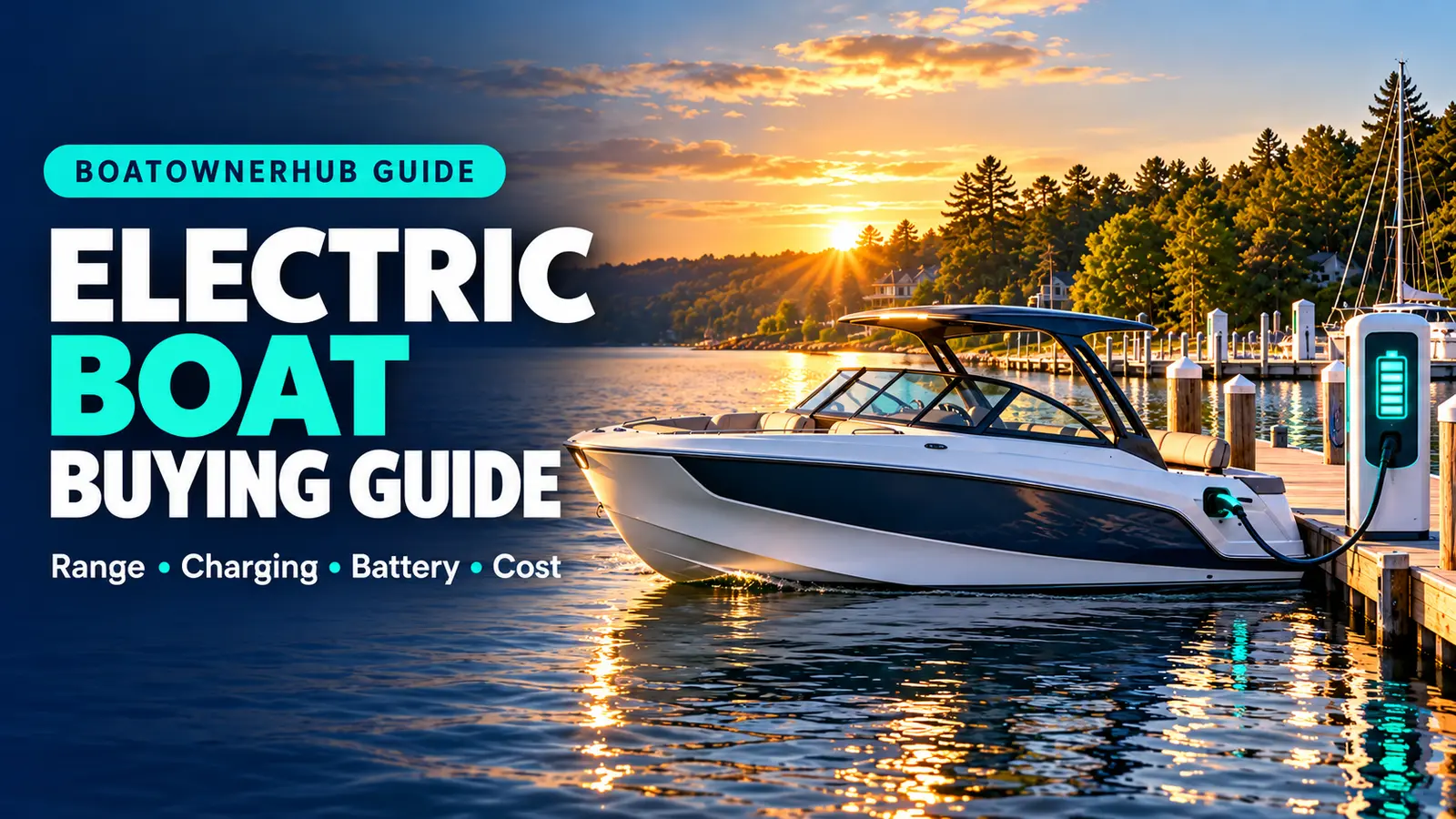
Editorial scene of a generic electric recreational boat. It does not represent a reviewed model.
When comparing electric boats for sale, begin with the route you need to complete and the charger available where the boat will live. Then compare range at a stated speed, usable battery capacity, recharge time on your actual electrical service, passenger and gear load, saltwater suitability, warranty coverage and nearby technical support. A boat with the longest headline range is not automatically the best choice for your water or ownership setup.
Quick answer: what should you check first?
- Define the normal route, speed, crew, load and weather window.
- Require a manufacturer range curve or range figure at a stated speed.
- Confirm the exact charging connection and power available at home, the marina or storage facility.
- Keep a conservative energy reserve for wind, current, detours and battery protection.
- Verify battery warranty, diagnostic access, service distance and replacement support in writing.
- Sea-trial the loaded boat on water similar to the intended use before accepting delivery.
Who is an electric boat a good fit for?
Electric propulsion is easiest to plan when trips are predictable, charging is dependable and there is time to recharge between outings. A lake day boat, harbor runabout, tender or short commuter can be a stronger fit than a boat expected to cover long distances at high speed without reliable charging.
| Use pattern | Why electric may fit | Question to resolve |
|---|---|---|
| Lake and reservoir day trips | Predictable routes and overnight charging can simplify planning | Does the lake restrict speed, horsepower or charging access? |
| Harbor or coastal day cruising | Quiet operation and repeatable marina routes | How do wind, tide, current and reserve affect the return leg? |
| Fishing and wildlife observation | Low noise at slow speed can suit the activity | Can the boat carry electronics, livewell and trolling loads without compromising propulsion reserve? |
| Watersports | Purpose-built models can provide strong torque and integrated controls | How much energy does repeated acceleration and speed consume? |
| Long-distance or remote cruising | Possible only with careful route and charging planning | Is dependable charging available at every required stop and alternate? |
Types of electric boats for sale
The phrase electric powered boats for sale covers several different products. A fully integrated electric boat is designed around its battery and propulsion system. A conventional hull with an electric outboard can offer simpler repowering, while a hybrid uses both electric and combustion systems. These choices should not be compared as if they have the same weight distribution, charging system or operating profile.
Purpose-built fully electric boats
The hull, battery, controls and propulsion are engineered as one package. This can improve integration and range reporting, but it also makes manufacturer support, software access and high-voltage service especially important.
Electric outboard boats
Small runabouts, fishing boats, pontoons and tenders may use an electric outboard with a separate battery bank. Confirm the boat builder approves the weight, mounting, steering, battery location and charging arrangement. Do not size the system by a simple horsepower conversion alone.
Electric hydrofoil boats
Hydrofoils reduce the hull area moving through the water at cruising speed, which can improve efficiency. They also introduce draft, foil, control-system, launch, impact and service considerations that belong in the sea trial and storage plan.
Hybrid boats
A hybrid can extend flexibility, but it retains fuel, exhaust and engine maintenance alongside batteries and electric equipment. Ask exactly which modes propel the boat, recharge the battery and support hotel loads.
Current electric boat examples to compare
The table is a starting point, not a ranking. Each manufacturer reports range differently. Slow-speed maximum range cannot be compared directly with range at cruising speed, and none of these figures should be treated as a trip guarantee.
| Model | Published configuration | Published performance context | Best comparison question |
|---|---|---|---|
| X Shore 1 | 21 ft, 63 kWh battery | Manufacturer lists 22 NM at 20-knot cruise, 18 NM at 30 knots and 50 NM at 5 knots | Which speed matches the route, and what reserve remains at that speed? |
| X Shore Eelex 8000 | 126 kWh battery, 170 kW propulsion | Manufacturer lists 20-knot cruise, 30-knot maximum and up to 100 NM including slow-speed operation | What is the range at the buyer's planned cruise speed and load? |
| Candela C-8 | Electric hydrofoil leisure boat | Manufacturer estimates 57 NM at 22 knots and describes AC and DC charging options | Do foil draft, water conditions, trailering and local service fit the owner? |
| Arc Sport | 23 ft, 232 kWh battery, 500 hp, seating for 15 | Purpose-built electric watersports boat with Level 1, Level 2 and DC charging support | Can the storage location supply the preferred charging method between high-load sessions? |
Other electric motor boats for sale may be smaller, slower or built around an electric outboard. That can be the better answer for an electric-only lake, a tender or a buyer who values simplicity over planing speed. Compare the complete system, not the marketing category.
How to compare electric-boat range correctly
Water resistance rises rapidly as many hulls go faster, so energy use per mile can change dramatically with speed. A manufacturer may publish a long maximum range at displacement speed and a much shorter figure at cruise or top speed. Record the speed beside every number.
- Start with the normal route: Add the outbound leg, return leg and realistic local maneuvering.
- Add alternate distance: Include a safe harbor, ramp or dock if the planned destination becomes unavailable.
- Model adverse conditions: Wind, current, chop, cold or heat, hull condition and load can change consumption.
- Keep a reserve: Choose a conservative reserve with the manufacturer, dealer and operator rather than planning to arrive near zero.
- Validate on the water: A loaded sea trial and early trip logs are more useful than a single brochure number.
Battery capacity, usable energy and warranty
Battery capacity is commonly shown in kilowatt-hours, but the nameplate number does not reveal how much energy the control system makes usable, how power is limited near empty or how temperature affects performance. Ask for the usable capacity, battery chemistry, thermal-management design, normal state-of-charge guidance and the conditions that can reduce power.
- Read the battery and propulsion warranty separately from the hull warranty.
- Ask what capacity-retention threshold, time, usage and exclusions apply.
- Confirm whether warranty and software support transfer to a second owner.
- Identify the nearest authorized diagnostic and high-voltage service location.
- Request the storage procedure for weeks, months and freezing or hot conditions.
- Ask how the boat can be moved, recovered or trailered after a propulsion or battery fault.
Charging: verify the complete path before buying
A charging claim matters only if the matching power is available where you will use it. Ask the dealer to state the connector, voltage, phase, current, charging power and time for each supported method. Then have the home, marina or storage facility confirm what it can actually supply.
| Charging question | Why it matters |
|---|---|
| Which AC and DC methods does this exact configuration support? | Options can differ by market, model year and installed charger |
| What is the charge time on the power I have? | A fast-charge headline may not apply to a normal marina pedestal or home circuit |
| Can the marina approve continuous charging? | Pedestal capacity, policies, metering and connector rules vary |
| What shore-side work is required? | Permits, conductor runs, protection, equipment and utility upgrades can change total cost |
| What happens during extreme temperatures? | Battery protection may slow charging or require a different storage plan |
Use marine and charging equipment exactly as the boat manufacturer specifies. Shore-side electrical installation belongs with qualified professionals and the authority having jurisdiction. Never improvise adapters, bypass protection or assume a familiar automotive connector makes every charger compatible.
Calculate the complete ownership cost
A purchase comparison should include more than electricity versus gasoline. Build one written first-year and five-year estimate for every finalist.
- Boat, battery, charger and installed options
- Delivery, tax, title, registration and financing
- Home, marina or storage charging equipment and electrical work
- Insurance requirements and agreed-value coverage
- Slip, storage, trailer and launch costs
- Hull, cooling, steering, running gear, anodes and safety-equipment maintenance
- Software, connectivity or subscription costs
- Travel or transport to authorized service
- Battery diagnostic, repair and eventual replacement planning
The boat maintenance cost guide can organize the non-propulsion costs. Use the boat fuel cost calculator only to build a comparable gasoline scenario, not to claim a universal electric savings percentage.
How to evaluate a dealer or private listing
For electric boats for sale USA searches, verify that the advertised configuration is supported in your state and near your normal water. A listing can use a model-family range or photo that does not match the boat being sold.
- Record the hull identification number, model year, propulsion serial numbers and battery identification.
- Match the installed battery, motor, charger, display and software to the written build sheet.
- Request the manuals, warranty documents, service history, charging records and recall status.
- Confirm included cables, adapters, trailer equipment and shore-side hardware.
- Ask for the current battery diagnostic report and who is authorized to interpret it.
- Make the purchase subject to an appropriate survey, electrical and propulsion inspection, and loaded sea trial.
New buyers should also use the first-time boat buying checklist for title, HIN, trailer, insurance and delivery checks that apply regardless of propulsion.
What to test during the sea trial
Plan a route that resembles normal use and begin with a documented state of charge. Carry a realistic crew and load when safe. Record speed, power, remaining energy, predicted range and temperature at repeatable points. Test low-speed control, acceleration, cruising behavior, steering, trim, noise, vibration, displays, alarms and charging after the run.
- Confirm the display explains energy use in a way the operator can act on.
- Check whether predicted range responds logically when speed and load change.
- Verify the boat can return with the planned reserve in ordinary conditions.
- Test boarding, storage, visibility and movement with the actual use case in mind.
- Ask the dealer to demonstrate shutdown, emergency isolation, towing and fault procedures from the manual.
Buying a used electric boat
A used electric boat needs normal hull, steering, trailer and safety checks plus battery and software due diligence. Age alone does not establish battery condition. Obtain a diagnostic report using the manufacturer's supported process and confirm whether the seller's account, connectivity, keys and ownership records can be transferred.
| Used-boat evidence | What to verify |
|---|---|
| Battery health report | Date, method, capacity measure, fault history and who issued it |
| Charging history | Available records, recurring faults and the equipment normally used |
| Warranty | Transferability, remaining term, capacity threshold and exclusions |
| Software and accounts | Supported version, ownership transfer, subscriptions and remote access removal |
| Service network | Authorized provider, transport plan and component availability |
| High-voltage system | Qualified inspection after impact, water intrusion, overheating or isolation faults |
Safety and ownership boundaries
An electric boat still needs required life jackets, distress equipment, navigation lights, ventilation where applicable, safe loading and a trained operator. The U.S. Coast Guard recreational boating resources remain the starting point for federal safety guidance, while state and local rules can add requirements.
High-voltage batteries and propulsion systems are not ordinary owner-service items. Follow the model manual for damaged batteries, water intrusion, collision, fire, towing, storage and emergency isolation. Keep passengers away from damaged equipment and use the manufacturer's emergency contacts and qualified responders.
A practical electric-boat buying scorecard
| Decision area | Pass condition |
|---|---|
| Mission | The boat safely carries the normal crew and gear on the intended water |
| Range | The route is supported at the planned speed with a conservative reserve |
| Charging | The exact charger and electrical supply are confirmed in writing |
| Storage | Temperature, shore power, trailer, draft and access fit the location |
| Support | Authorized service, diagnostics and replacement components are practical |
| Cost | The five-year budget includes infrastructure, insurance, service and battery planning |
| Trial | The loaded sea trial confirms control, performance, energy use and recharge |
Compare the mission before comparing the badge
Use the first-time buyer checklist to verify the boat, seller, documents, inspection, sea trial and complete ownership plan.
Electric boat buying questions
How far can an electric boat travel on one charge?
Range depends on speed, hull efficiency, battery capacity, payload, wind, current, water conditions and temperature. Compare manufacturer range figures only when the stated speed and test conditions are similar, then keep a conservative operating reserve.
How long does it take to charge an electric boat?
Charging time depends on usable battery capacity, the boat's onboard charger, the available electrical service, temperature and the starting state of charge. Ask the manufacturer for times on the exact AC or DC equipment you will use.
Can you charge an electric boat at home?
Some trailerable electric boats can use compatible home charging equipment, but the outlet, circuit, charger and installation must match the manufacturer's requirements and applicable electrical rules. A qualified electrician should assess new shore-side equipment.
Are electric boats suitable for saltwater?
Some are designed for saltwater and some are not. Confirm the exact model's corrosion protection, cooling arrangement, anodes, connectors, warranty terms and post-use procedure before purchasing.
Are electric boats cheaper to maintain?
Electric propulsion can remove engine oil, spark plugs and some fuel-system service, but the boat still needs hull, steering, cooling, electrical, running-gear, trailer and safety-equipment care. Battery and high-voltage service access also belongs in the ownership budget.
Should you buy a used electric boat?
A used electric boat can be a sound purchase when identity, ownership, battery condition, charging history, software support, warranty transfer, service records and replacement-component availability are verified by qualified specialists.
What is the best electric boat to buy?
The best fit is the boat that can complete the normal route with reserve, charge where it is stored, carry the real crew and gear, operate safely in the intended water and receive service within a practical distance.
Sources and editorial method
BoatOwner Hub checked model examples against official manufacturer pages on October 15, 2026. The comparison uses each source's stated speed and context instead of combining unlike range figures. It is not a hands-on test, price quote or substitute for the boat's manuals, dealer documentation, survey or qualified electrical inspection.
- X Shore 1 official specifications
- X Shore Eelex 8000 official specifications
- Candela C-8 official product page
- Arc Sport official specifications
- Arc Sport official charging guide
- U.S. Coast Guard recreational boating resources