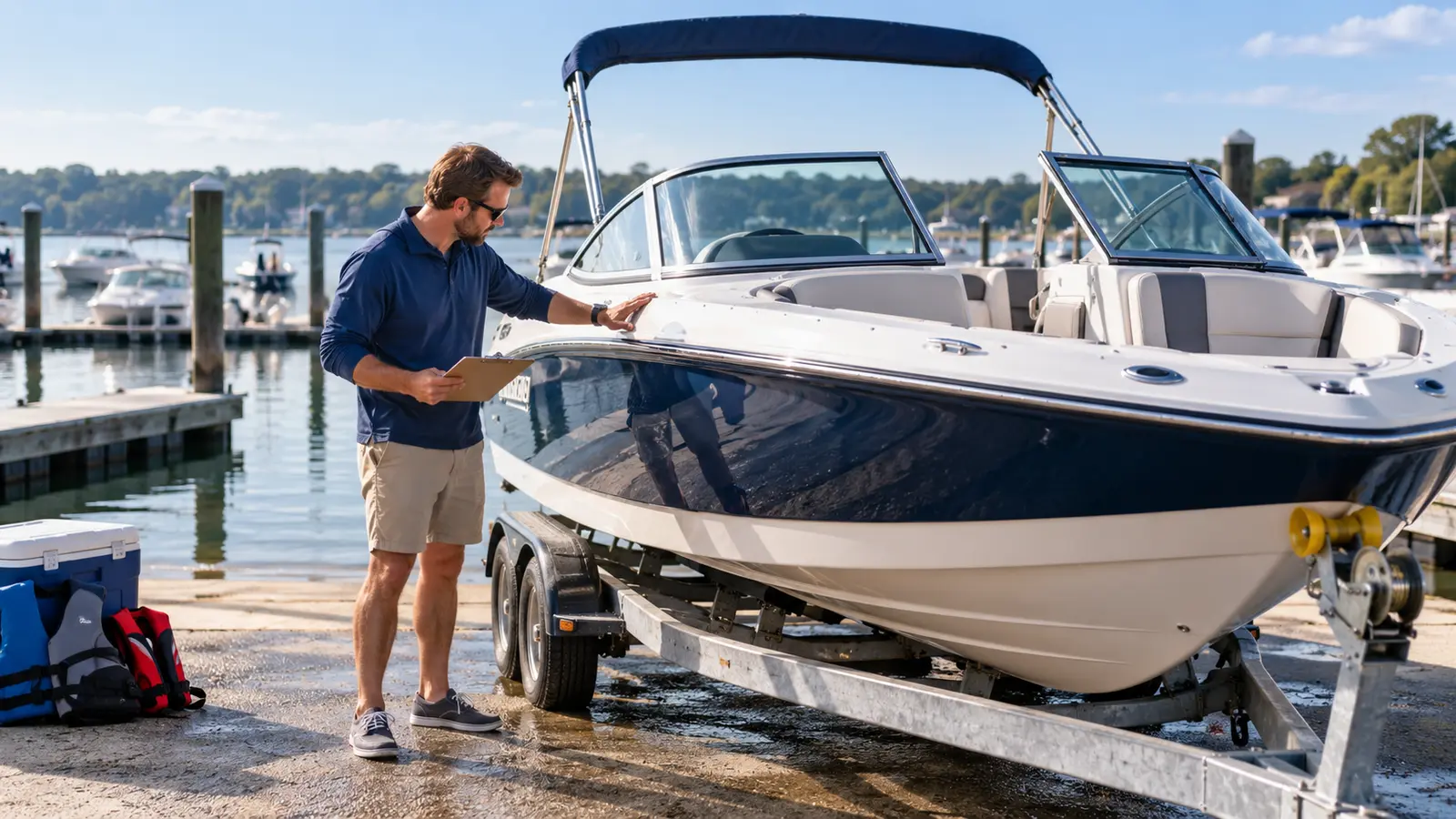
Buying a boat for the first time should begin with the trips you will actually take, not the longest feature list at the dealership. Define your normal water, crew, activity, storage and towing limits. Then compare boats that fit those limits, price the complete first year, verify the hull identification and paperwork, inspect the boat and engine, and complete an on-water trial before accepting it.
Quick answer: How should a first-time boat buyer choose?
Choose the smallest and simplest boat that safely handles your normal crew, water and activity. Confirm where it will live, how it will launch, what the loaded package requires on land and what routine service costs locally. For a used boat, match the hull identification number to the documents, review service records, check for recalls, inspect the structure and systems, and arrange an appropriate sea trial, survey and engine evaluation before money becomes nonrefundable.
1. Write the mission before viewing boats
A first time boat buyer can lose the comparison before it begins by mixing incompatible goals. A shallow-river fishing setup, a family day boat, an offshore center-console and an overnight cruiser solve different problems. Write one primary mission and one secondary mission. If a feature serves neither, it should not control the purchase.
- Water: sheltered lake, river, bay, coastal water or offshore route
- Normal crew: the people and total load on most trips, not a once-a-year maximum
- Main activity: fishing, cruising, watersports, sandbar trips, sailing or overnighting
- Home base: trailer, driveway, rack, dry stack, slip or mooring
- Access: ramp depth, parking, tide, bridge clearance and seasonal limits
- Land limits: tow vehicle ratings, trailer storage and the driver's comfort level
Visit the normal launch and storage location before choosing a boat. Measure the real space, note the ramp and ask for written prices. The Boating Near You directory can help identify marinas, ramps, storage and services to verify locally.
Before choosing a hull, use our boat storage comparison to check the space, access and complete service quote.
Buyers considering a different propulsion system can use the electric boat buying guide to compare range at speed, charging access, battery support and service coverage before choosing a hull.
2. Choose a boat type that fits the first 80 percent of trips
| Boat type | Often fits | First-buyer question |
|---|---|---|
| Small aluminum or utility boat | Sheltered water, simple fishing and light towing | Does the hull and freeboard fit the actual wind, chop and load? |
| Bowrider or deck boat | Family day trips, cruising and some watersports | Can everyone move, sit and board safely with normal gear aboard? |
| Center-console | Fishing, open deck access and mixed coastal use | Does the weather protection and seating fit the family as well as the fishing? |
| Pontoon | Roomy social use, calm to moderate water and stable seating | Will the beam, trailer, wind exposure and storage arrangement work? |
| Cabin boat | Weather protection and overnight capability | Can the budget support the extra plumbing, electrical and onboard systems? |
| Sailboat | Sailing-focused ownership and slower travel | Do the berth, rig, draft, training and maintenance plan fit the owner? |
For fishing, start with the Fishing Boats pillar. Buyers comparing freshwater options can use the lake fishing boat guide to separate hull, layout and power decisions.
3. Treat size as a complete-system decision
More length can add room, freeboard, fuel capacity and capability, but it also changes weight, storage, handling, maintenance and operating cost. Do not select a length from passenger count alone. Compare the capacity label where applicable, the owner's manual, expected load, water conditions and usable layout.
Walk through the boat with a normal trip in mind. Place imaginary coolers, life jackets, lines, fenders, fishing equipment and bags. Check whether hatches open without blocking movement, whether children and older passengers can board, and whether the helm has clear visibility. A boat that feels large at a show can become crowded after safety gear and personal equipment arrive.
Anglers can use the fishing boat cost guide for current package examples and a first-year ownership worksheet.
4. Budget for the ownership system, not only the purchase
The purchase price is one line. Add tax, title and registration, insurance, storage or slip fees, launch access, required safety equipment, fuel, scheduled engine service, winterization where needed, trailer maintenance and a repair reserve. Financing can also change the total cost and the insurance requirements.
Use the boat maintenance cost guide to build a service and repair fund from the exact boat, engine, climate and local quotes. Estimate trip fuel with the boat fuel cost calculator. Do not rely on a universal percentage or a seller's memory of last year's expenses.
- Request the engine and boat service schedules.
- Obtain storage, insurance and registration estimates for the exact setup.
- Price overdue service and known defects before negotiating.
- Keep optional electronics and cosmetic upgrades separate from safety and maintenance.
- Reserve cash for the first season instead of spending the full budget on purchase day.
5. Compare new versus used without shortcuts
| Question | New boat | Used boat |
|---|---|---|
| Condition uncertainty | Usually lower, but delivery inspection still matters | Depends heavily on history, storage, inspection and records |
| Warranty | May include separate hull, component and engine coverage | Confirm what is transferable, active and excluded |
| Price and depreciation | Higher initial price may include current equipment and support | Lower entry price may be offset by deferred maintenance |
| Selection | Choose current models and factory options | Choose from available condition and configuration |
| Best evidence | Written specification, warranty, delivery checklist and sea trial | Title, HIN, service records, survey, engine check and sea trial |
A warranty is not a substitute for fit, and a low used price is not proof of value. Compare the final written cost of a safe, dependable boat that is ready for the intended use.
6. Verify identity, ownership and safety records
Before paying a deposit that can become nonrefundable, identify the seller and compare the hull identification number, or HIN, on the boat with the title, registration and sales documents. A HIN is not the same as a state registration number. Do not accept an altered, missing or mismatched HIN without resolving it through the proper authority.
- Confirm the seller can legally transfer the boat, engine and trailer.
- Check whether a lien exists and document how it will be released.
- Match serial numbers and model details on included engines and major equipment.
- Search the U.S. Coast Guard recreational boat recall database by manufacturer, model and year.
- Use the NASBLA state boating contacts to reach the current registration and titling authority.
- Confirm trailer title, registration and identification requirements separately.
The Coast Guard explains that the HIN is unique to the vessel and must be verified accurately. If the displayed HIN and documents do not agree, stop the transaction until the issuing authority provides a clear path.
7. Inspect the boat as a hull, engine and trailer package
A clean interior can hide expensive problems. Inspect the boat in daylight with systems accessible. Ask permission before operating equipment, opening sealed areas or performing tests. For a used boat, choose an independent marine surveyor and engine technician when the boat's value, age, complexity or insurer justifies it.
Hull and structure
Look for impact damage, cracks, repairs, blistering, corrosion, loose hardware, leaks, soft areas and water intrusion. Construction differs, so the correct inspection method depends on the hull material and design. A generic tap test or moisture reading without construction knowledge can be misleading.
Engine and propulsion
Record the exact model, serial number and engine hours, then compare them with service records and the manufacturer's schedule. Check cold starting, warnings, cooling flow where applicable, shifting, steering, trim, leaks, vibration and full operating behavior during the on-water trial. Engine hours need context: maintenance and operating history matter as much as the number.
Fuel, electrical and onboard systems
Inspect fuel hoses and connections, batteries, protection devices, wiring, pumps, lights, navigation equipment and ventilation. Do not bypass safety devices to make a sale test work. Unlabeled wiring, household components, fuel odor, overheated connections or recurring breaker trips deserve qualified evaluation.
Trailer
Check the trailer identification, GVWR, tires, bearings, brakes, lights, coupler, chains, winch, bunks or rollers and corrosion. Determine the loaded package weight, not only the published dry hull weight. Verify that the tow vehicle, hitch and trailer ratings fit the planned load and follow the vehicle and trailer manufacturer instructions. Continue with the boat trailer maintenance checklist.
8. Use the sea trial to test the mission
A dockside start does not show how the boat planes, steers, shifts, cools, vibrates, drains or carries the expected crew. Agree in writing on the trial scope, who pays for fuel and launch, and what happens if the boat cannot be tested.
- Start the engine cold when practical so a warmed engine does not hide starting behavior.
- Observe idle, acceleration, shifting, steering and trim across the normal operating range.
- Check gauges, alarms, charging, bilge pump, navigation lights and other included systems.
- Watch for leaks, unusual smoke, odor, heat, vibration or water entry.
- Confirm visibility, seating, movement and boarding with realistic load distribution.
- Record findings and make the final agreement depend on clearly defined acceptable results.
A seller demonstration is not an independent inspection. If the surveyor or technician finds a concern, obtain a written repair scope and current price before renegotiating or walking away.
9. Understand labels and certification without overreading them
Many recreational boats must meet applicable federal manufacturing requirements, and certain boats carry capacity information. The Coast Guard's federal requirements guide explains equipment and operating obligations, but a compliant label does not tell you whether a boat suits your water or whether a used example was maintained well.
NMMA states that its certification program checks participating boats against applicable standards and goes beyond minimum Coast Guard requirements in specified areas. Verify the current builder on the NMMA certified manufacturer list. Certification is useful evidence, not a replacement for inspection, maintenance records or operator training.
10. Put the complete deal in writing
The written purchase agreement should identify the boat, engine, trailer and included equipment by serial number where practical. List the price, deposit terms, financing, survey and sea-trial conditions, delivery date, included repairs, warranty documents, title transfer and what happens if a condition is not met.
Confirm insurance before delivery and ask whether the insurer requires a survey, training, layup period, navigation limit or specific equipment. Confirm registration, taxes and local education requirements with the relevant authorities. Keep copies of the advertisement, disclosures, inspection reports, receipts and signed transfer documents.
Plan the first 90 days before delivery
- Complete required education and practice slow-speed control, docking and trailer handling.
- Read the boat, engine, electronics and trailer manuals.
- Set up the required safety equipment using current federal, state and local rules.
- Create a service log with dates, engine hours and next-due items.
- Complete baseline maintenance that is due or undocumented.
- Use the boat maintenance checklist for trip, monthly and seasonal inspections.
- Take the first trips in forgiving weather and water with a conservative load.
Common first-time boat buying mistakes
- Choosing for the biggest imagined trip instead of the normal trip
- Ignoring storage, launch access or tow-vehicle limits until after purchase
- Spending the full budget on the boat and leaving no repair reserve
- Accepting a warm engine, short dockside run or seller statement as an inspection
- Failing to match the HIN and ownership documents
- Paying extra for old electronics without valuing the hull and engine first
- Skipping a written agreement because the seller seems trustworthy
- Buying more systems than the owner can learn, maintain and afford
First boat buying checklist
- ☐ Primary water, crew and activity written down
- ☐ Storage, launch, bridge and access limits verified
- ☐ Boat type, size and capacity fit normal trips
- ☐ Full first-year ownership budget completed
- ☐ Insurance, registration, tax and education requirements checked
- ☐ HIN, title, registration, liens and seller identity matched
- ☐ Coast Guard recall search completed
- ☐ Hull, engine, systems and trailer inspected
- ☐ Independent survey or specialist evaluation arranged where appropriate
- ☐ On-water trial completed under agreed conditions
- ☐ Written offer lists the complete package and contingencies
- ☐ First 90-day training and maintenance plan ready
Frequently asked questions
What is a good first boat to buy?
A good first boat is the smallest, simplest model that safely handles your normal water, crew and activity while fitting your storage, launch and towing limits. For many buyers, a single-engine open boat with accessible systems is easier to learn and budget for than a larger cabin boat with multiple systems.
Should a first-time boat buyer choose new or used?
New can offer warranty coverage and fewer unknowns, while used can reduce the purchase price and initial depreciation. Condition, records, inspection findings and total required work matter more than the label. Compare complete written offers and inspect either choice before accepting delivery.
Do you need a marine survey before buying a used boat?
The need depends on the boat's value, age, construction, complexity, insurer and lender. An independent survey and separate engine evaluation can be especially useful when defects are difficult to see or expensive to repair. Confirm the required scope with the insurer and lender before hiring anyone.
How much should a first-time buyer budget beyond the boat price?
Build a local written budget for tax, registration, insurance, storage, launch access, fuel, scheduled service, trailer work, required safety equipment and a repair reserve. There is no reliable universal percentage because location, boat type, condition and usage change the total.
Sources and method
This guide separates general decision support from state-specific legal and transaction advice. Identity, recalls, federal equipment and state-contact guidance were checked against current national sources. Boat suitability, survey scope, taxes, insurance and contract terms still require boat-specific and local verification.
- U.S. Coast Guard: Hull identification guidance
- U.S. Coast Guard: Recreational boat recalls
- U.S. Coast Guard: Federal requirements for recreational boats
- NASBLA: State boating contacts
- NMMA: Boat and yacht certification