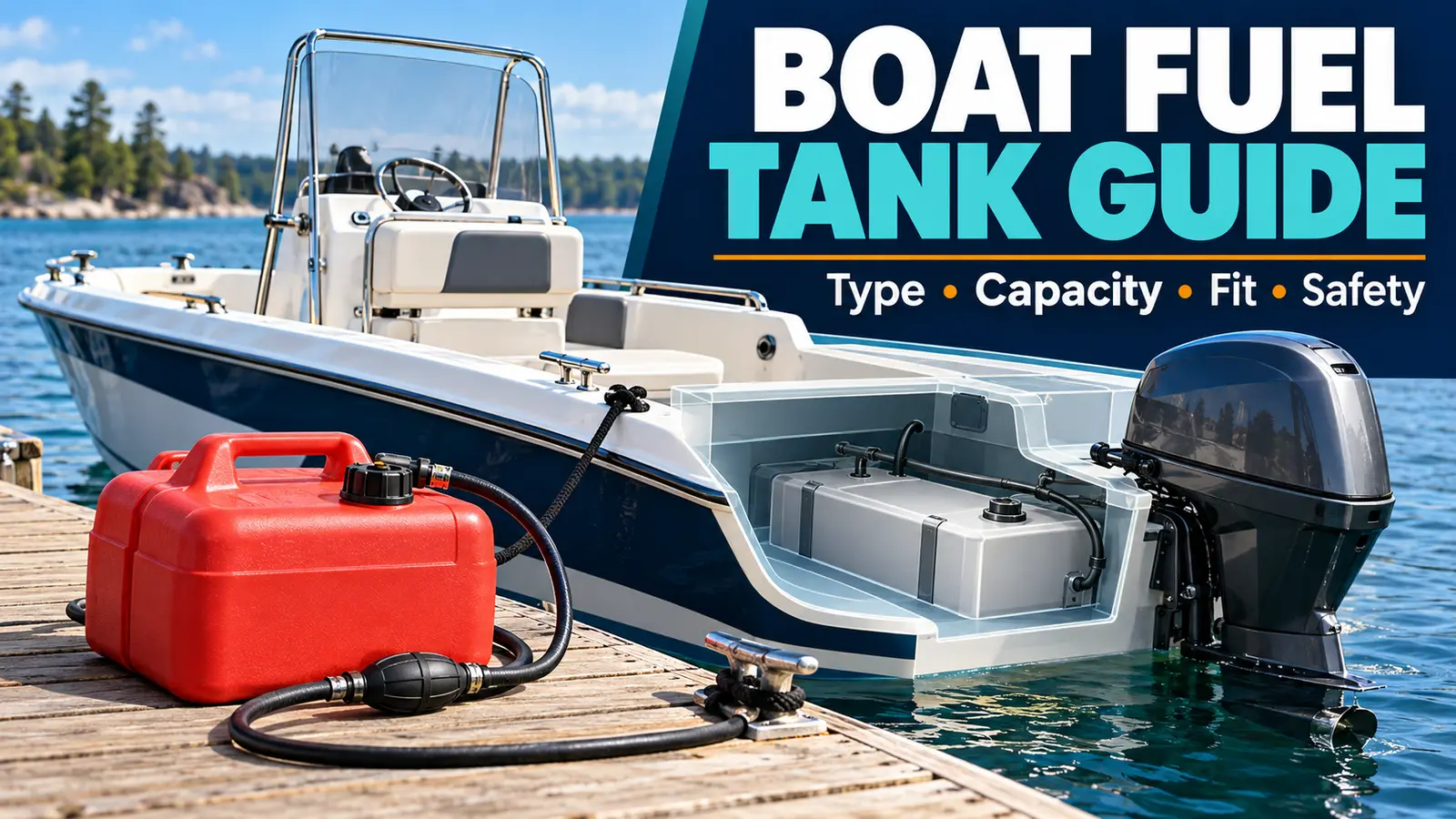
Editorial composite comparing generic portable and permanent fuel-tank arrangements. It is not an installation diagram or a specific product.
The right boat fuel tank is the approved tank type that fits the boat's space and weight limits, carries enough usable fuel for the intended trip, connects with the correct marine-rated components, and can be secured, ventilated, inspected and refueled exactly as the boat, engine and tank makers require. Start with the vessel's original design and manuals. Capacity alone is never enough to choose safely.
Quick answer: check these seven points before buying
- Tank type: portable or permanently installed, as intended by the boat.
- Fuel and compliance: marine gasoline use, approved fuel grade and required emissions features.
- Real dimensions: the tank plus access for the cap, venting, gauge, fittings and fuel line.
- Loaded weight: tank, fuel and securing hardware within the boat's loading and placement limits.
- Complete connection: compatible pickup, fittings, approved hose, primer bulb where required and engine connector.
- Ventilation and pressure control: the system used exactly as designed, with no modified cap or blocked vent path.
- Inspection access: the tank and every visible connection remain reachable for checks.
Portable vs. permanent boat fuel tanks
| Tank arrangement | Where it commonly fits | What must be verified |
|---|---|---|
| Portable marine fuel tank | Smaller outboard boats designed for a removable tank | Approved location, size, securing method, cap and pressure behavior, hose route and engine connector |
| Permanently installed fuel tank | Boats designed around an integrated fill, vent, pickup and mounting system | Original specifications, tank material and shape, mounting, fill and vent routing, sender, hoses and access |
| Auxiliary or replacement tank | Only when the boat design and manufacturer guidance support the arrangement | Loading, balance, plumbing, isolation, ventilation, electrical ignition protection and applicable standards |
A portable boat gas tank is not automatically compatible with every outboard boat. A permanent tank is not simply a larger portable container hidden below deck. Each arrangement has different fill, vent, mounting and inspection requirements. Do not convert between them based only on available space.
Federal boat-manufacturing requirements in 33 CFR Part 183, Subpart J address gasoline fuel systems on covered boats. Owners should preserve the approved system design and use parts intended for the application instead of improvising around those requirements.
Choose capacity by range, load and fit
The best capacity is not the largest tank that can be squeezed into a compartment. It is the capacity allowed by the boat, with an installation space that preserves access and with enough fuel for the route under realistic conditions.
- Identify the allowed arrangement. Check the boat and engine manuals, capacity label, original tank information and builder support.
- Measure actual fuel use. Use your boat's observed gallons per hour at the intended cruise setting and normal load. Brochure numbers are only a starting point.
- Estimate the full trip. Include the return leg, expected idling and detours. Wind, waves, current, hull condition, trim and load can all change burn.
- Add a conservative reserve plan. The Coast Guard's boater guide describes the one-third rule as one third out, one third back and one third in reserve. Route, weather and boat-specific factors may call for more conservative planning.
- Check loaded weight and balance. Fuel is a significant movable load. Follow the boat maker's placement and capacity guidance.
Use the Boat Fuel Cost Calculator to turn measured fuel burn, distance, speed and local price into a trip estimate. It is a planning tool, not a substitute for the vessel's range and reserve requirements.
Measure the tank and the service envelope
Length, width and height are only the physical tank body. Your measurement also needs to account for:
- cap removal and refueling access;
- gauge or sender clearance;
- fuel pickup and fittings;
- the approved hose bend radius and route;
- expansion and pressure behavior described by the maker;
- straps, brackets or cradles;
- inspection and cleaning access around the tank;
- movement of seats, hatches, steering components and battery cables.
Make a cardboard footprint or dimensioned sketch before ordering. Then confirm the full model number. Tanks with similar names and the same nominal gallons can have very different profiles.
Material, fuel compatibility and compliance labels
Common marine fuel tank materials include molded fuel-compatible plastic and metals specified for marine fuel service. Material choice is tied to the tank design, mounting, exposure and fuel system. A generic utility can, automotive tank or unmarked container is not a substitute for an approved marine tank.
The U.S. EPA explains that emission standards for gasoline marine engines also address evaporative emissions from fuel tanks and fuel lines. Modern portable systems may behave differently from older manually vented tanks because the cap, valve, tank and fuel line work together to manage vapor. Never drill, defeat, swap or leave open a cap or valve unless the exact instructions require it.
Check the tank label and documentation for the manufacturer, part number, intended fuel, nominal capacity, compliance information and operating instructions. If the label is unreadable or the history is unknown, that uncertainty belongs in the replacement decision.
Venting and pressure are system features
Gasoline changes volume with temperature, and vapor must be managed by the system's intended design. A permanent tank normally has a defined fill and vent arrangement. A current portable tank may use an automatic valve or pressure-management cap. Neither should be modified to imitate the other.
- Do not block a permanent tank's vent opening or route.
- Do not loosen, drill or replace a portable cap with an unverified cap to release pressure.
- Do not store a portable tank in an enclosed space that the boat or tank instructions do not approve.
- Do not assume swelling, odor or liquid around a fitting is normal. Stop and inspect according to the maker's instructions.
The Coast Guard's current Boater's Guide to Federal Requirements explains ventilation requirements and fueling precautions for spaces that can contain gasoline vapor. Use the exact vessel arrangement, not a generic diagram, to determine what applies.
Already chose the tank? Use the boat fuel line guide to match hose rating, inside diameter, primer bulb, connectors and routing from tank to engine.
Before starting an inboard or sterndrive gasoline engine, use the boat blower timing guide for the four-minute ventilation rule and vapor check.
Match every fuel-line connection
A tank's threaded outlet or quick connector does not prove that the rest of the system fits. Confirm the entire path:
- tank pickup and fitting size;
- manufacturer-approved fitting and sealant method;
- marine fuel hose type and inside diameter;
- primer bulb orientation if the engine system uses one;
- tank-side and engine-side connector families;
- routing that avoids kinks, heat, sharp edges and moving parts;
- clamps or supports specified by the component makers;
- fuel grade and ethanol compatibility for every component.
Then perform the maker's inspection or leak-check procedure before starting the engine. If parts from several generations are mixed, or the existing hose has no readable rating, have the system identified rather than choosing by appearance.
Use the fuel approved for the engine and system
Read the engine manual and the pump label. The EPA states that E15 cannot be used in nonroad vehicles such as boats. Do not assume a fuel approved for a newer passenger vehicle is approved for a marine engine.
Ethanol compatibility is also a system question. A tank may be labeled compatible while an older hose, primer bulb, seal or connector is not. The narrowest approved component controls the choice.
Secure the tank without hiding it
A portable tank needs to stay in its intended position as the boat accelerates, turns, pounds through waves and changes trim. Use the boat and tank maker's approved securing points or restraint system. Do not run a strap across the cap, gauge, fitting or fuel line, and do not wedge the tank so tightly that it cannot expand or be inspected as intended.
For a permanent tank, mounting supports must protect the tank from movement, abrasion, water traps and incompatible materials. Because replacement can affect structure, wiring, ventilation and fuel plumbing, match the original design and bring unclear work to a qualified marine technician.
Inspect before each trip and investigate change
Pre-trip checks
- No raw-fuel odor
- No wetness, staining or cracked parts
- Cap, fittings and visible hose secure
- Tank held in the approved position
- Vent path clear where applicable
- Fuel line protected from chafe and kinks
Stop and get help
- Persistent fuel odor
- Liquid fuel or active seepage
- Cracks, deep corrosion or deformation
- Damaged cap, valve, fitting or pickup
- Loose permanent mounting
- Unexplained pressure or engine fuel-starvation symptoms
Do not start an engine while gasoline vapor or a leak is present. The Outboard Motor Maintenance guide places fuel-system checks within the wider engine routine, and the Boat Maintenance Checklist helps keep repeat inspections on schedule.
A verified 12-gallon portable-tank example
Affiliate disclosure: The linked BoatOwnerHub review contains an Amazon affiliate link. If you buy through that review, BoatOwner Hub may earn a commission at no extra cost to you. This guide does not claim hands-on testing.

Attwood 8812LPG2 12-Gallon Fuel Tank
Useful when: an outboard boat is designed for a portable tank, needs this capacity and has a secure, ventilated location sized for the taller 8812LPG2 model.
Important limitation: this is not the separate low-profile model. The hose, fittings, engine connector, loaded weight and installation space still need independent confirmation.
Read the complete fuel-tank reviewExact product identity and specifications were checked in the published review.Browse the separate Engine & Fuel product-review collection for source-checked exact-model pages. A product review answers “does this model fit?” while this guide answers “what must the whole fuel-tank decision cover?”
Refuel without bringing vapor aboard
The Coast Guard advises refueling portable tanks ashore. For onboard fills, its boater guide says to close hatches and openings, extinguish smoking materials, turn off engines and electrical equipment, remove passengers, keep the nozzle in contact with the fill, wipe up spills, ventilate afterward and run the blower for at least four minutes where applicable. Do not start until fuel vapors are eliminated.
- Read the tank, engine, boat and fuel-dock instructions before handling fuel.
- Use only the approved fuel and verify the pump label.
- Keep ignition sources off and fuel away from hot surfaces.
- Fill portable tanks ashore on a stable surface, not loose inside the boat.
- Do not overfill; follow the tank's fill guidance and leave the required expansion space.
- Clean spills immediately using the facility's safety procedure.
- Inspect the cap and fittings before returning the tank to its approved location.
Boat fuel tank buying checklist
- □ Confirm the boat is designed for portable or permanent tank use.
- □ Record the exact engine model, fuel requirements and connector family.
- □ Measure the tank body and the access needed above and around it.
- □ Check nominal capacity against loaded weight, placement and practical trip range.
- □ Verify marine fuel compatibility, compliance labeling and current documentation.
- □ List every hose, fitting, pickup, primer bulb and connector in the complete system.
- □ Confirm the vent or pressure-management design without modification.
- □ Plan the approved restraint or permanent mounting method.
- □ Preserve inspection access to the cap, gauge, fittings, hose and surrounding space.
- □ Arrange professional assessment for fixed-tank replacement, leaks or undocumented modifications.
Frequently asked questions
Should I choose a portable or permanent boat fuel tank?
Use the fuel-tank arrangement approved for the boat. Portable tanks are common on smaller outboard boats built for removable tanks. Permanent tanks suit boats designed around an installed fuel system, but replacement and related fuel-system work should follow the boat maker's specifications and may require a qualified marine technician.
What size boat fuel tank do I need?
Start with the boat manufacturer's permitted tank arrangement, available space and weight limits. Then compare usable trip range using measured fuel burn, expected conditions and a conservative reserve plan. A larger tank is not automatically better if it overloads the boat or cannot be secured, accessed and ventilated correctly.
Can you use E15 gasoline in a boat?
No. The U.S. EPA states that E15 cannot be used in nonroad vehicles such as boats. Follow the engine and fuel-system manuals for the approved fuel grade and ethanol limit, and verify the pump label before fueling.
Are plastic boat fuel tanks safe?
An approved marine tank made from fuel-compatible material can be suitable when it matches the boat's intended system and is installed, secured and ventilated as required. Do not substitute a general-purpose container or assume any plastic tank is acceptable for marine use.
When should a boat fuel tank be replaced?
Stop using the system and obtain qualified help when a tank leaks, is cracked, badly corroded, deformed, has damaged fittings or cap components, or cannot hold pressure and vent as its instructions require. Persistent fuel odor also needs investigation before the engine is started.
Where should a portable boat fuel tank be filled?
The U.S. Coast Guard advises refueling portable tanks ashore. Keep the fill nozzle in contact with the tank, keep ignition sources off, wipe up spills and follow the tank, engine, marina and local rules before returning the tank to its approved secured location.
Sources and methodology
This guide separates federal design and fueling guidance, manufacturer product information and BoatOwnerHub editorial analysis. It does not replace the boat, tank or engine manual. No price, rating, sales, durability or hands-on testing claim is included.
- U.S. Coast Guard: A Boater's Guide to the Federal Requirements for Recreational Boats
- Electronic Code of Federal Regulations: 33 CFR Part 183, Subpart J, Fuel Systems
- U.S. EPA: E15 Fuel Registration and prohibited uses
- U.S. EPA: Regulations for Marine Spark-Ignition Engines and evaporative emissions
- Attwood official catalog: portable marine fuel tanks and 8812LPG2 specifications