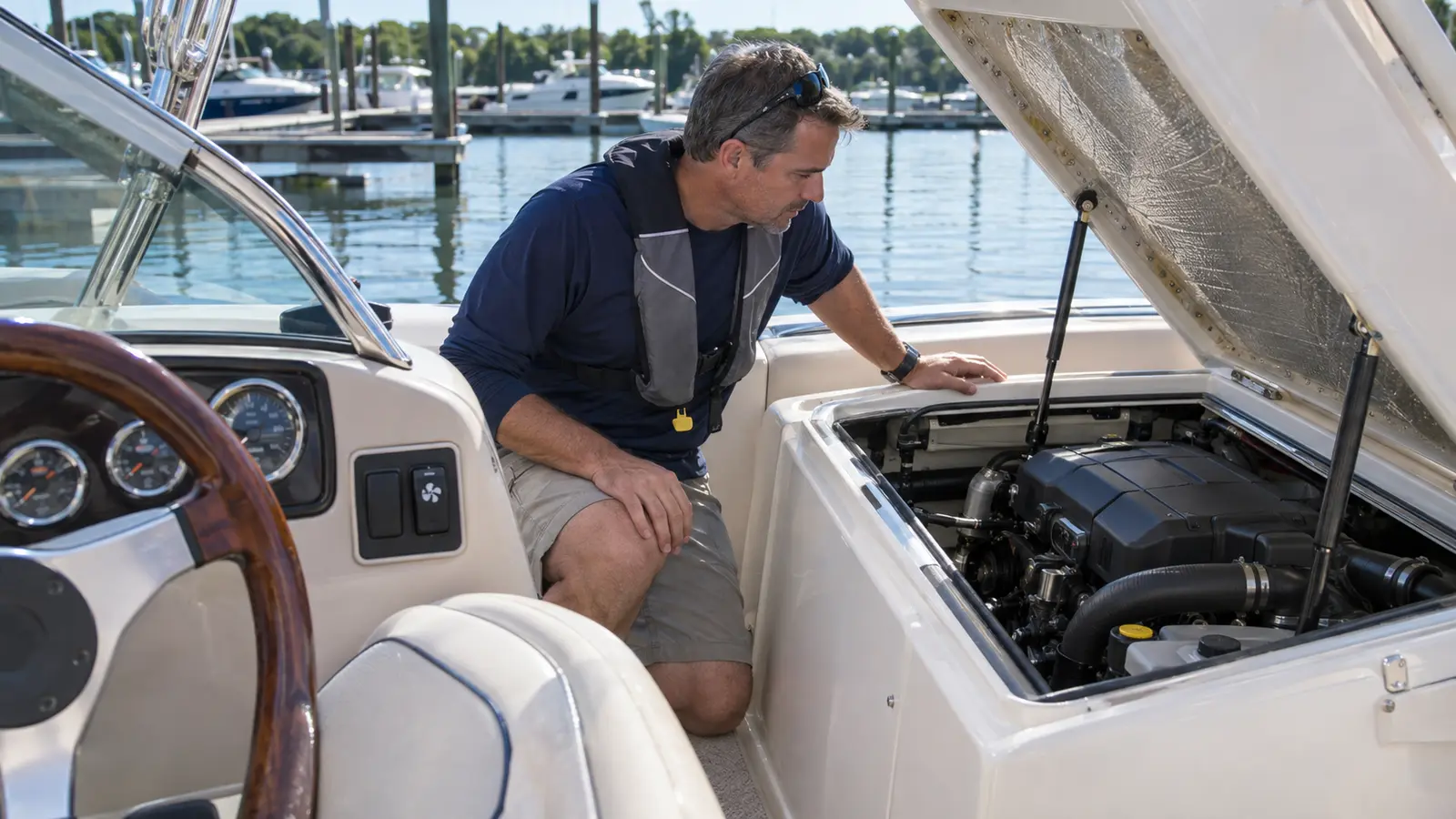
Original editorial image showing a pre-start engine-compartment check; exact blower controls and inspection procedures vary by boat.
Operate the engine-compartment blower for at least four minutes before starting a gasoline inboard or sterndrive engine, then check the engine compartment and bilge for gasoline vapor. Repeat that sequence after fueling and before any restart. If you smell gasoline, see fuel or suspect a leak, do not start the engine, even after the blower has run.
The short answer by situation
| Situation | Blower action | Next check |
|---|---|---|
| Before the first start of the day | Run at least four minutes | Inspect and check for gasoline odor before starting |
| After fueling | Ventilate, then run at least four minutes | Do not start until all vapor or leakage concerns are eliminated |
| Restarting after a stop | Follow the label and repeat the pre-start sequence | Check the bilge and engine space again |
| Idling or moving slowly | Follow the boat manual; many builders require continued blower operation | Keep ventilation openings clear |
| Gasoline odor remains | The four-minute timer is not permission to start | Stop, isolate ignition sources and correct the cause |
Where the four-minute rule comes from
The federal powered-ventilation rule in 33 CFR 183.610 requires the warning label near the ignition switch on boats that require an exhaust blower. The label tells operators to run the blower for four minutes and check the engine-compartment bilge for gasoline vapors before starting.
The U.S. Coast Guard's current Boater's Guide to Federal Requirements repeats the same pre-start warning. The four minutes are a minimum ventilation period, not proof that the compartment is safe.
After fueling: use a complete restart sequence
- Secure the boat and shut down engines, motors, flames and ignition sources before fueling.
- Keep passengers ashore and close openings as the fueling procedure requires.
- Hold the nozzle against the fill and avoid topping off.
- Wipe up fuel and deal with any spill using the marina and environmental procedure.
- Open and ventilate the boat as its manual directs.
- Run the blower for at least four minutes.
- Check the bilge, engine space and blower exhaust for gasoline odor.
- Start only when no leak or vapor concern remains.
The BoatUS Foundation fueling procedure places the four-minute blower run and sniff check after ventilation and before the engine is restarted.
Should the blower stay on while running?
Federal text establishes the pre-start warning, but operating instructions can be more specific. Many gasoline inboard and sterndrive manuals direct owners to keep the blower running at idle or below cruising speed, when natural airflow may be limited. Some builders recommend leaving it on whenever the engine is running.
Use the warning label and manual for the exact boat. Do not copy another boat's switch routine. If the manual is missing, obtain the correct replacement from the builder or dealer before deciding when the blower can be switched off.
What the blower does and does not do
Gasoline vapor is heavier than air and can collect low in an enclosed compartment. A correctly installed exhaust blower draws from the lower portion of that space and discharges outside the boat. The system depends on unobstructed ducts, the correct blower, sound wiring and a clear outlet.
The blower can
- Move air through the engine compartment
- Reduce vapor accumulation before starting
- Support ventilation at idle or slow speed when required
The blower cannot
- Repair a leaking hose, tank or fitting
- Confirm that every vapor pocket is gone
- Replace a visual and odor check
- Make a spark-producing component safe
Five checks before turning the key
- □ The blower runs and air is moving from the exhaust vent.
- □ Intake and exhaust openings are not blocked by gear, covers or debris.
- □ The bilge and accessible fuel-system areas are dry and free of gasoline odor.
- □ The blower has run for at least four minutes.
- □ The boat's label and manual do not require additional steps.
Do not rely on sound alone to prove useful airflow. A blower can make noise while a hose is disconnected or an outlet is obstructed. Use only the inspection method allowed by the boat manual.
What about outboard-powered boats?
The powered-blower rule centers on enclosed compartments with permanently installed gasoline engines and remote starting. A typical outboard engine sits outside the hull, so the same engine-box routine may not apply. However, enclosed spaces containing permanently installed tanks or unprotected electrical equipment can have separate ventilation requirements.
Use the exact vessel label and manual rather than treating “outboard” as a universal exemption. If an enclosed compartment smells of gasoline, the safe response is still not to start or energize equipment.
If the blower does not work
Do not start a gasoline inboard or sterndrive engine when its required blower is inoperative. Check only owner-service items identified by the manual, such as the correct fuse or breaker and visible vent obstruction. Do not bypass the switch, substitute a household fan or create sparks in the compartment. Have the ventilation system repaired and verified before operation.
Related fuel and safety guides
Boat Fuel Tank Guide
Understand tank type, venting, capacity and leak warning signs.
Boat Fuel Line Guide
Inspect hose, primer bulb, connectors and routing as one system.
Boat Safety Equipment
Build the wider onboard safety checklist around the exact boat.
Boat Emergency Kit
Prepare communications, first aid and response equipment.
Frequently asked questions
How long should you run a boat blower before starting?
Run it for at least four minutes before starting a gasoline inboard or sterndrive engine when the boat's warning label and manual call for powered ventilation. Check the engine compartment and bilge for gasoline vapor before starting.
Should the blower run after fueling?
Yes. After fueling, ventilate as the boat manual directs, operate the blower for at least four minutes and check for gasoline odor before starting an inboard or sterndrive engine. Do not start while vapor or a leak is suspected.
Should the blower stay on while the boat is running?
Follow the exact boat manual. Many builders direct owners to keep the blower on at idle and below cruising speed, and some recommend continuous use while the engine is running.
Do outboard boats need a bilge blower?
A typical open outboard installation does not use an enclosed gasoline engine compartment in the same way, but enclosed spaces containing fuel-system components may still have ventilation requirements. Follow the boat's label and manual.
What if I still smell gasoline after four minutes?
Do not start the engine. Shut down ignition sources, keep people clear, follow the boat's emergency procedure and have the leak or vapor source corrected before operating the boat.
Sources and methodology
This guide distinguishes the federal boat-manufacturing warning label, U.S. Coast Guard operator guidance, fueling procedure and model-specific manual instructions. It does not replace the label or manual on the boat.
- 33 CFR 183.610: Powered ventilation system
- U.S. Coast Guard: Boater's Guide to Federal Requirements
- BoatUS Foundation: Proper fueling procedure