The main parts of a fishing boat are the bow, stern, port and starboard sides, hull, deck, gunwales, helm or tiller, propulsion system, transom and bilge. Fishing boats may also add casting decks, livewells, fish boxes, rod storage, trolling-motor mounts and sonar. The names stay useful across boat types, but the exact structure, plumbing and equipment location must be confirmed on the builder's diagram and owner's manual.
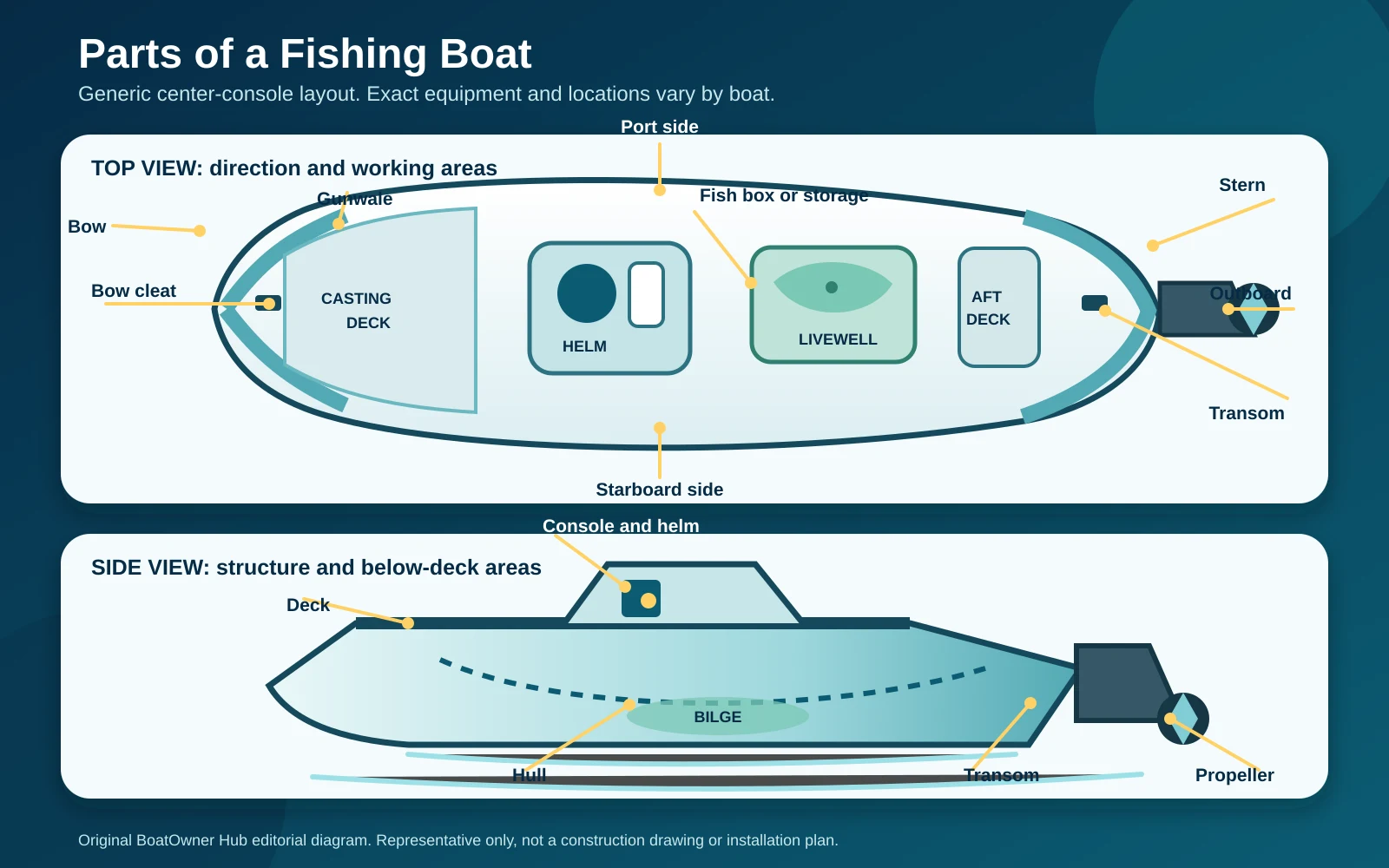
Learn the directions first
- Bow: the front of the boat.
- Stern: the back of the boat.
- Port: the left side when you face the bow.
- Starboard: the right side when you face the bow.
- Forward and aft: toward the bow and toward the stern.
These terms stay fixed to the boat. If you turn around and look aft, port does not switch to your new left. Using the fixed names reduces confusion when someone calls out a dock line, obstruction or equipment location.
Fishing boat parts by name, location and job
This table starts with the parts found on many powered recreational fishing boats, then adds common fishing features. A feature can move or disappear depending on whether the boat is a jon boat, bass boat, multi-species boat, center console, pontoon, kayak or inflatable.
| Part | Where it is | What it does | What a new owner should verify |
|---|---|---|---|
| Bow | Front end | Leads the boat through the water and may support seating, a casting deck or trolling motor | Clear visibility, secure gear and the boat's approved boarding or seating positions |
| Stern | Back end | Holds aft deck space and often propulsion, boarding or fishing equipment | Weight distribution, clear access and propeller hazard awareness |
| Port and starboard | Left and right while facing the bow | Give every person the same fixed reference | Use the terms for docking, wiring routes and safety communication |
| Hull | Watertight body below and around the deck | Provides buoyancy, shape and structure | Material, damage, drains, fittings and the builder's load limits |
| Deck | Working surface above the hull | Supports people, seating, storage and fishing activity | Non-slip condition, drainage, clear movement and secure hatches |
| Gunwale | Upper edge of each hull side | Joins or caps the hull and deck edge and may carry rails, cleats or factory tracks | Do not assume it can accept a clamp or drilled mount without approval |
| Transom | Aft structural face | Connects the hull sides and may support an outboard or fittings | Condition, builder limits, motor hardware and the hull identification number location |
| Helm or tiller | Operator's control position | Steers and controls propulsion; a console helm may also carry gauges and electronics | Visibility, reach, engine cut-off switch, controls and uncluttered sightlines |
| Bilge | Lowest interior part of the hull | Collects incidental water so it can be detected and removed by the boat's system | Access, pump and switch operation, drains, hoses and the cause of any new water |
| Cleat | Deck or gunwale fitting | Provides a designed point for dock or anchor lines | Purpose, condition, backing and a line path that does not create a trip hazard |
| Outboard or inboard propulsion | At or near the stern | Moves and steers the boat, depending on the installation | Exact controls, cooling, fuel, service access and safe starting procedure |
| Propeller | Below or behind the propulsion unit | Turns engine power into thrust | Keep people clear, stop the engine before inspection and follow the engine manual |
| Casting deck | Raised bow or stern fishing platform | Creates a clear work area for casting | Traction, edges, seating rules, hatch security and weight distribution |
| Livewell or baitwell | Built into a deck, seat base or aft module | Circulates or refreshes water for live bait or retained fish when designed for that job | Intended use, capacity, valves, pumps, strainers, overflow and cleaning procedure |
| Fish box | Insulated compartment or removable storage | Holds retained catch and ice rather than operating as an aquarium | Drainage, cleaning, insulation and whether it is actually plumbed as a livewell |
| Rod and tackle storage | Gunwale racks, lockers, consoles or deck compartments | Controls hooks, rods and small equipment underway | Length, drainage, latches and clear emergency access |
| Sonar display and transducer | Display at the helm; transducer at the transom, hull or trolling motor | Shows depth and sonar returns from the selected system | Power, cable route, transducer compatibility and clean water flow |
| Trolling motor mount | Usually on the bow, sometimes the stern | Supports low-speed electric propulsion for boat positioning | Structure, shaft clearance, voltage, batteries, breaker, wiring and stowed footprint |
Hull, deck, gunwale and transom: the structural group
The hull is the boat's main body, while the deck is the surface people stand or sit on. The gunwale, often pronounced “gunnel,” is the top edge along the hull side. The transom is the aft face that connects the hull sides and, on many outboard boats, carries the engine mounting loads.
Those names do not make every visible surface a mounting point. A clear panel can hide flotation, wiring, hoses, structure or an inaccessible backing area. Before drilling for a rod holder, sonar display or trolling-motor accessory, use the exact boat and accessory instructions. The aluminum fishing boat accessory guide explains why factory tracks, backing and dissimilar-metal isolation matter on compatible aluminum boats.
The helm, controls and operator zone
A console boat places the steering wheel, throttle or shift controls, engine instruments and often electronics at the helm. A small jon boat or skiff may use a tiller on the outboard instead. The layout should let the operator see ahead, reach the controls and use the engine cut-off switch without fishing gear blocking the area.
The U.S. Coast Guard explains that an engine cut-off switch stops propulsion machinery when the operator is displaced from the helm, and its current FAQ describes when the link must be used on covered recreational vessels. The same FAQ notes that a hull identification number is commonly found on the starboard outboard side of the transom. These are reasons to learn the names before a safety or service conversation, not reasons to apply one layout to every boat.
Livewell, baitwell and fish box are different jobs
A livewell or baitwell is a water system. It may use an intake, pump, spray head or aeration, overflow and drain, but the design and intended occupants vary. A fish box is normally storage for retained catch and ice. Some builders use convertible compartments, so the label and plumbing diagram control.
Likely livewell or baitwell
- Has labeled fill or recirculation controls
- Includes water inlet, overflow and drain paths
- Builder documentation gives capacity and operating steps
- Requires pump, strainer and plumbing care
Likely fish box or storage
- Designed to hold retained catch, ice or gear
- May be insulated without active circulation
- Uses drainage rather than life-support plumbing
- Should not be treated as a livewell without builder confirmation
Do not run a pump dry, close an unknown valve or add a chemical based on a generic diagram. Read the boat manual, then include the compartment in the cleaning and winterization routine that applies to its actual plumbing.
Bilge, pumps and below-deck spaces
Discover Boating describes the bilge as the lowest area of the hull where water may collect. On a small open boat it may be visible near the stern; on a decked boat it can extend through hidden compartments. A bilge pump can remove water, but it does not explain why water arrived or make every leak acceptable.
Learn which hatch gives safe access, where the pump and automatic switch sit, which outlet belongs to the system and how the manual says to test it. If water level, odor, color or pump cycling changes, identify the source before the next trip. Use the boat bilge cleaning guide for safe cleaning and disposal boundaries.
How the layout changes by fishing boat type
| Boat type | Common layout difference | What not to assume |
|---|---|---|
| Jon or utility boat | Open benches, simple tiller propulsion and few enclosed systems | That a bench, rib or gunwale can accept any aftermarket mount |
| Bass boat | Large casting decks, low seating, storage, livewells and bow trolling motor | That every hatch is dry storage or every rear compartment is a livewell |
| Multi-species aluminum boat | Walk-through or side console, deeper cockpit, windshield and flexible seating | That hull length alone predicts freeboard, capacity or rough-water fit |
| Center console | Walk-around helm, open bow and stern work areas, often more systems | That console space guarantees an easy cable route or transducer location |
| Pontoon | Deck sits on pontoons rather than a conventional single hull | That “bilge,” “transom” or mounting advice transfers directly from a monohull |
| Kayak or inflatable | Portable or integrated seating, limited capacity and model-specific mounting points | That powered-boat hardware, drilling or weight placement is suitable |
Use the types of fishing boats guide to compare the missions and layouts before using the anatomy words to inspect one model.
Five-minute owner walkthrough
- Stand at the stern and face the bow. Say “port” and “starboard” while pointing to the fixed boat sides.
- Follow the deck edge. Identify gunwales, cleats, rails, hatches and safe movement routes.
- Find the operator zone. Locate steering or tiller controls, throttle, instruments, engine cut-off switch and emergency gear access.
- Trace fishing systems without operating them. Identify livewell, baitwell, fish box, rod storage, trolling-motor mount, sonar display and transducer.
- Open only approved service access. Find the bilge pump, batteries, breakers, fuel components, seacocks or drains that the manual expects the owner to inspect.
Fishing boat anatomy checklist
- □ I can point to bow, stern, port and starboard without turning the terms around.
- □ I know which surfaces are hull, deck, gunwale and transom.
- □ I can reach the helm controls and engine cut-off switch without gear blocking them.
- □ I know which compartment is a livewell, baitwell, fish box or plain storage.
- □ I know how to access and test the bilge pump as the manual directs.
- □ I know where the batteries, breakers and major system shutoffs are located.
- □ I have recorded the exact boat, engine and equipment models.
- □ I will not drill, clamp or route wiring from a generic anatomy diagram.
- □ Passengers know the approved seats, handholds and no-ride areas.
- □ The owner's manual remains the final source for this boat's layout and operation.
Frequently asked questions
What are the main parts of a fishing boat?
Most fishing boats have a bow, stern, port side, starboard side, hull, deck, gunwales, helm or tiller controls, propulsion, bilge area and fittings such as cleats. Fishing layouts may also add casting decks, rod storage, livewells, fish boxes, trolling-motor mounts and sonar equipment.
What is the difference between the bow and stern?
The bow is the front of the boat and the stern is the back. Port means the boat's left side when facing the bow, while starboard means the right side.
Is a livewell the same as a fish box?
No. A livewell is normally a water-filled system intended to keep bait or catch alive when used correctly. A fish box is storage for retained catch and may be insulated or chilled. The exact plumbing, capacity and intended use come from the boat builder.
Where is the bilge on a fishing boat?
The bilge is the lowest interior area of the hull where incidental water may collect. Access, pump location and compartment layout vary, so use the boat manual rather than assuming every hatch reaches the bilge.
What is the gunwale of a boat?
The gunwale, often pronounced gunnel, is the upper edge of the hull side where the hull and deck structure meet. It may carry cleats, rails or factory mounting tracks, but it is not a universal drilling surface.
Do all fishing boats have the same parts?
No. A jon boat, bass boat, center console, pontoon, kayak and inflatable fishing boat can share directional terms while using very different hull, deck, storage, propulsion and fishing systems.
Sources and editorial method
This is a research-based beginner guide, not a hands-on evaluation of one boat. BoatOwner Hub created the labeled illustration and combined established anatomy terms with fishing-layout analysis. The diagram intentionally avoids model-specific construction claims. No price, rating, product endorsement or affiliate link is included.
- Discover Boating, Parts of a Boat: Anatomy and Basics
- BoatUS Foundation, Boating Safety Study Guide
- U.S. Coast Guard, Engine Cut-Off Switch FAQ
- U.S. Coast Guard, Federal recreational boating regulations index