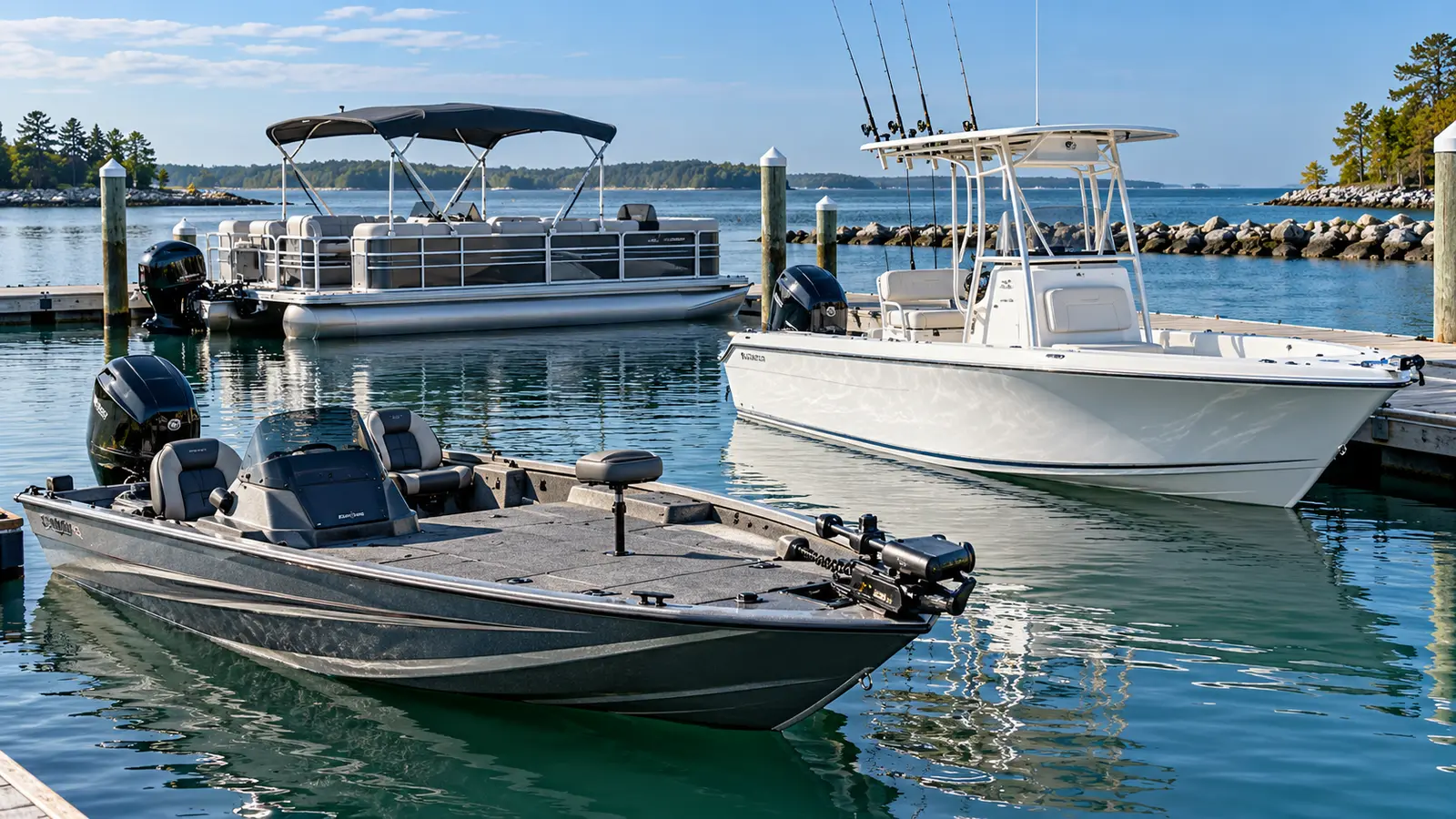
The main types of fishing boats are bass boats, aluminum multi-species boats, jon and mod-V boats, deep-V boats, bay boats, flats skiffs, center consoles, walkarounds, fishing pontoons, inflatables and fishing kayaks. None is best everywhere. Start with the water and fishing method, then compare the exact hull, freeboard, capacity, deck, storage, propulsion and land-side requirements.
Quick answer: How do fishing boat types differ?
Fishing boat types are working layouts built around different conditions. Bass boats favor casting decks and speed. Multi-species boats add cockpit depth and flexibility. Jon boats trade rough-water comfort for simplicity and shallow access. Bay boats and skiffs specialize in distinct inshore depths. Center consoles and walkarounds add coastal or offshore capability. Pontoons prioritize space, while inflatables and kayaks solve storage and access problems. Category names help narrow the field, but the exact model and operating limits decide whether it fits.
Compare the main fishing boat types
The different types of fishing boats overlap. A center console can be a small bay boat or a large offshore boat. An aluminum hull can be a jon boat, bass boat or deep-V multi-species boat. Treat the table as a way to identify candidates, not as permission to use any boat wherever the category sometimes operates.
| Type | Often fits | Main strength | Important limit |
|---|---|---|---|
| Bass boat | Casting on lakes and reservoirs | Large casting decks, tackle storage and quick spot changes | Low profile and specialized layout may be less flexible for families or rough water |
| Aluminum multi-species | Mixed inland fishing and changing techniques | Adaptable cockpit, moderate weight and useful freeboard | Ride, finish and capacity vary widely by hull |
| Jon or mod-V | Small, sheltered, shallow water | Simple, light and easy to launch | Flat sections can pound in chop and low sides require conservative use |
| Deep-V fishing boat | Large or exposed lakes and cold-water fishing | Deeper hull entry, higher sides and protected cockpit | More draft, weight, power and storage demand |
| Bay boat | Bays, sounds and mixed inshore water | Open casting space with more capability than a flats skiff | Still not automatically an offshore boat |
| Flats skiff | Very shallow, protected inshore fishing | Minimal draft and clear sight-fishing deck | Low freeboard and light weight narrow the weather window |
| Center console | Inshore to offshore fishing, depending on design | Walkaround deck access and flexible rigging | Weather protection, seating and offshore ability vary dramatically |
| Walkaround or cuddy | Coastal fishing with more shelter | Protected helm or berth with usable side access | Cabin structure reduces open deck space and adds systems |
| Fishing pontoon | Sheltered water, larger crews and relaxed fishing | Room, seating and easy movement at rest | Windage, beam, storage and rough-water limits need planning |
| Inflatable | Portable use on sheltered water | Compact storage and transport | Setup, hooks, wind, floor space and propulsion limits |
| Fishing kayak or canoe | Protected water, quiet access and minimal storage | Low cost of entry and access to small water | Limited load, weather protection, visibility and mobility |
Reviewed options for portable fishing setups
If storage and towing narrow your shortlist to portable craft, compare the boat itself and how you will protect small essentials. These options solve different problems and are not substitutes for one another.

Intex Excursion 4
Fits: a packable inflatable option for occasional sheltered-water outings.
Check first: Setup time, floor space and operating limits differ from a rigid fishing boat. Verify the exact model capacity and manual.
Go to review page
HEETA 5L Dry Bag
Fits: compact storage for small belongings on kayaks, inflatables and open boats.
Check first: Five liters is limited storage. A roll-top dry bag is not intended for underwater storage.
Go to review pageFreshwater fishing boats
Bass boats
A bass boat is built around active casting. Low bow and stern platforms give anglers space to work lures. Pedestal seats, low-profile tackle compartments, rod lockers, a bow-mounted trolling motor and fast planing performance are common. The layout is efficient for one or two serious anglers moving between marked spots.
The same specialization can be a limitation. Deck steps, low seating and a low profile may not suit children, passengers who need secure seating, or large exposed lakes. Compare how the boat behaves with the normal load, not only how much deck it shows at the dealership.
Aluminum multi-species boats
For anglers who troll, cast and move between lakes, an aluminum multi-species boat is often the broadest freshwater starting point. These boats commonly provide a deeper cockpit, higher sides, movable seating, storage and space for electronics. Moderate towing weight can make ownership practical without turning the boat into a shallow-water specialist.
“Multi-species” is a layout idea, not a performance guarantee. Hull angle, freeboard, width, weight and construction change the ride. Compare the exact model with the wind exposure, ramps and crew on your normal lakes. The lake fishing boat guide goes deeper on this decision.
Jon and mod-V boats
Jon boats use a flat or nearly flat bottom, while a mod-V adds more shape at the bow. They can be light, simple and useful in sheltered shallows, small rivers and backwaters. An open floor also makes it easier to customize seating and storage.
Flatter hulls can feel steady at rest but hit short chop more abruptly. Low sides and light weight make wind, wake and shifting loads more consequential. Standing raises the center of gravity, so a stable feeling at the dock is not a reason to ignore capacity, balance or conditions.
Deep-V and walleye-style boats
A deep-V multi-species boat is aimed at bigger inland water, trolling and conditions where more freeboard and a sharper hull entry help. The protected cockpit can serve cold-weather anglers and families better than a low bass-boat layout. The tradeoff is a heavier package with more draft, power, storage and trailer demand.
Shallow-water and inshore fishing boats
Flats skiffs
A flats skiff is designed to reach protected shallow water with minimal draft. Broad casting platforms, simple storage and a poling platform may support sight fishing. Lightweight construction and a low profile help access, but they also reduce shelter and can make wind and open-water crossings more demanding.
Bay boats
Bay boats sit between flats skiffs and larger coastal center consoles. They typically keep open casting decks while adding more freeboard, seating and range than a dedicated skiff. This makes them useful for bays, sounds, larger estuaries and mixed inshore techniques.
Do not treat “bay boat” as an offshore rating. Some designs can make limited nearshore trips in good conditions, but the exact hull, drainage, fuel range, construction, communications and operator plan matter. Review the builder's intended use and make conservative weather decisions.
Small center consoles
A center console puts the helm near the middle so anglers can move around it. In a compact inshore boat, that circulation can be more useful than maximum seating. Check whether the console, leaning post, cooler and livewell still leave a safe path when rods and passengers are aboard.
Coastal and offshore fishing boats
Offshore center consoles
Larger offshore center consoles use deeper hulls, higher freeboard, self-draining cockpit designs and substantial fuel and power systems to support coastal and offshore work. Open deck access helps when fighting fish, handling lines or rigging several stations.
That capability adds cost and complexity. Multiple engines, large fuel capacity, advanced electronics, offshore safety gear, trailer or slip requirements and more exposed seating all need a complete plan. A boat called a center console may be a shallow inshore model or a large offshore platform, so the label alone says little about safe operating conditions.
Walkarounds and cuddy fishing boats
Walkarounds and fishing-oriented cuddy cabins add a protected helm, small berth or enclosed space while preserving side access toward the bow. They can extend the season and give passengers shelter. Cabins add weight, reduce some open deck area and introduce more systems to inspect and maintain.
Family and multi-use fishing boats
Fishing pontoons
Fishing pontoons appeal to owners who value seating, stable movement at rest and room for a larger crew. Fishing packages may add livewells, rod holders, open bow or stern areas and trolling-motor provisions. They work best when the home water, slip, storage and trailer can support their beam and wind exposure.
A wide deck does not eliminate capacity or balance limits. Furniture and passengers can also make it harder to work a fish around the boat. Decide whether the normal trip is fishing with some social use or social boating with some fishing, then inspect the layout accordingly.
Dual-console and fish-and-ski layouts
Dual-console and fish-and-ski boats trade specialized deck area for passenger seating, windshield protection and watersports features. They can fit households that genuinely split time between activities. Test whether rods, tackle, tow gear and safety equipment each have a secure place. A layout that tries to do everything can become cluttered if storage is an afterthought.
Portable and human-powered fishing craft
Inflatable fishing boats
Inflatables solve a real ownership problem when rigid-boat storage or towing is not available. They can support quiet outings on sheltered water when the exact craft's manual, capacity, propulsion limits and local rules fit the trip. Setup time, drying, hook management, wind and limited rigid mounting surfaces are part of the decision.
Fishing kayaks and canoes
Fishing kayaks and canoes provide quiet access, minimal storage demand and a low barrier to small water. Sit-on-top fishing kayaks can add gear tracks, pedal drives and stable seating, while canoes offer flexible cargo space. Both have tighter load, visibility, weather and self-rescue considerations than larger motorboats.
Plan for cold-water immersion, changing wind, vessel visibility, launch recovery and accessible flotation. Human-powered craft are not automatically low-risk because they lack an engine.
Hull and layout matter more than the category label
Most planing fishing boats use some form of flat, modified-V or deeper-V bottom. A flatter bottom can plane with less power and work in shallower water, but the tradeoff is a harsher ride as waves build. More V can improve the ride in chop but normally adds draft and power demand. The BoatUS Foundation boat types and hull guide explains the basic planing and displacement distinction.
Layout changes the practical job just as much as hull shape. Check these details on every candidate:
- Freeboard and cockpit depth: how exposed people feel and how the boat carries a working load
- Casting space: whether anglers can cast and land fish without crossing paths
- Seating and handholds: whether the normal crew can ride and move securely
- Storage: whether rods, tackle, anchors and required safety gear stay secured and accessible
- Drainage: how water leaves the cockpit and how pumps, scuppers and drains are maintained
- Propulsion and power: outboard, trolling motor, batteries, charging and electronics treated as one system
- Land-side fit: loaded trailer weight, beam, height, storage length and launch access
The U.S. Coast Guard's federal recreational-boating guide stresses safe loading, balance and accessible life jackets. Seats do not determine safe capacity. Use the boat's capacity information and manual, distribute people and gear carefully, and reduce load as conditions worsen.
After choosing the right type, use the fishing boat cost guide to compare current package examples and total ownership needs.
How to choose among types of boats for fishing
- Name the normal water. Separate protected ponds, rivers, large reservoirs, bays, nearshore routes and offshore trips. Do not merge them into “all-around use.”
- Name the fishing method. Casting, trolling, drifting, fly fishing, bait fishing and running offshore each place different demands on deck, storage and control.
- Count the real load. Include people, fuel, batteries, tackle, coolers, anchor, safety gear and any livewell water. Follow the exact capacity limits.
- Set land-side limits. Verify the loaded trailer, tow vehicle, ramp, parking, storage, beam and height before falling in love with a layout.
- Price and test the exact boat. Compare manuals, service access, ownership cost, an appropriate inspection and an on-water trial. Use the first boat buying checklist for the full transaction.
Owners of jon boats and multi-species hulls can use the aluminum fishing boat accessories guide to plan mounting, storage, sonar and handling gear.
Check the complete ownership fit
Boat type affects recurring cost. More hull, engines, batteries, pumps, upholstery and onboard systems mean more work to inspect and maintain. Use the boat maintenance cost guide and fuel cost calculator to create a boat-specific plan. If trolling and electronics are central, use the battery runtime calculator for a conservative planning estimate.
After selecting a layout, organize it so safety equipment and movement paths stay clear. The boat fishing essentials checklist covers trip preparation, and the small-boat gear organization guide helps test a compact deck.
Boats and trailers can move aquatic organisms between waters. Follow local inspection rules and the National Park Service's Clean, Drain, Dry guidance before moving to another launch.
Match reviewed electronics to the boat you choose
Once hull and layout fit your trips, select electronics for the actual job. Basic sonar and a chartplotter serve different needs. Check mounting space, power and transducer installation before buying.

Humminbird PiranhaMAX 4
Fits: a small powered fishing boat whose owner wants a compact 4.3-inch Dual Beam sonar display.
Check first: This model does not include GPS or chart mapping. Plan a suitable transom location and power supply.
Go to review page
Simrad GO9 XSE with 83/200 Transducer
Fits: boats with room and power for a 9-inch chartplotter, GPS and sonar display.
Check first: This exact package uses an 83/200 transducer, not Active Imaging 3-in-1. Check helm space, mounting and network requirements.
Go to review pageCommon boat-type comparison mistakes
- Using a category label as proof of offshore capability or shallow draft
- Choosing for maximum passenger count instead of a realistic fishing load
- Comparing hull length while ignoring freeboard, beam, weight and usable deck
- Assuming a flatter boat that feels stable at rest will ride better in chop
- Buying a specialized bass, flats or offshore layout for mostly mixed family use
- Ignoring loaded trailer weight, storage height, ramp depth or tow-vehicle limits
- Pricing optional electronics before the propulsion, battery and charging plan
- Treating an inflatable, pontoon or kayak as risk-free because it looks stable or slow
Frequently asked questions
What are the main types of fishing boats?
Common recreational fishing boat types include bass boats, aluminum multi-species boats, jon and mod-V boats, deep-V boats, bay boats, flats skiffs, center consoles, walkarounds, fishing pontoons, inflatables and fishing kayaks. The categories overlap, so intended water and layout matter more than the label alone.
What type of fishing boat should I buy?
Choose from your normal water, crew, fishing method, launch, storage and towing limits. A multi-species aluminum boat is versatile on many inland waters, a bay boat or skiff suits distinct inshore jobs, and an offshore center console or walkaround is built for more exposed water. Verify the exact boat rather than relying on the category name.
What is the most versatile fishing boat type?
There is no universal winner. An aluminum multi-species boat is often versatile for inland fishing, while a moderate-size center console can handle many inshore and coastal uses. Versatility still depends on hull, freeboard, seating, storage, propulsion and the conditions the operator will accept.
What is the difference between a bass boat and a multi-species boat?
A bass boat emphasizes low casting decks, tackle storage and fast movement between spots. A multi-species boat commonly adds higher sides, deeper cockpit space, more protected seating and a layout that supports trolling or mixed techniques. Exact designs vary by builder and model.
Sources and method
This guide groups common recreational fishing craft by intended use while treating category boundaries as flexible. Hull, capacity, loading and environmental guidance were checked against current national boating-education and government sources. Exact performance and operating limits must come from the boat and equipment manufacturers.
- BoatUS Foundation: Boat types, hulls and capacity
- U.S. Coast Guard: A Boater's Guide to Federal Requirements for Recreational Boats
- National Park Service: Aquatic invasive species prevention