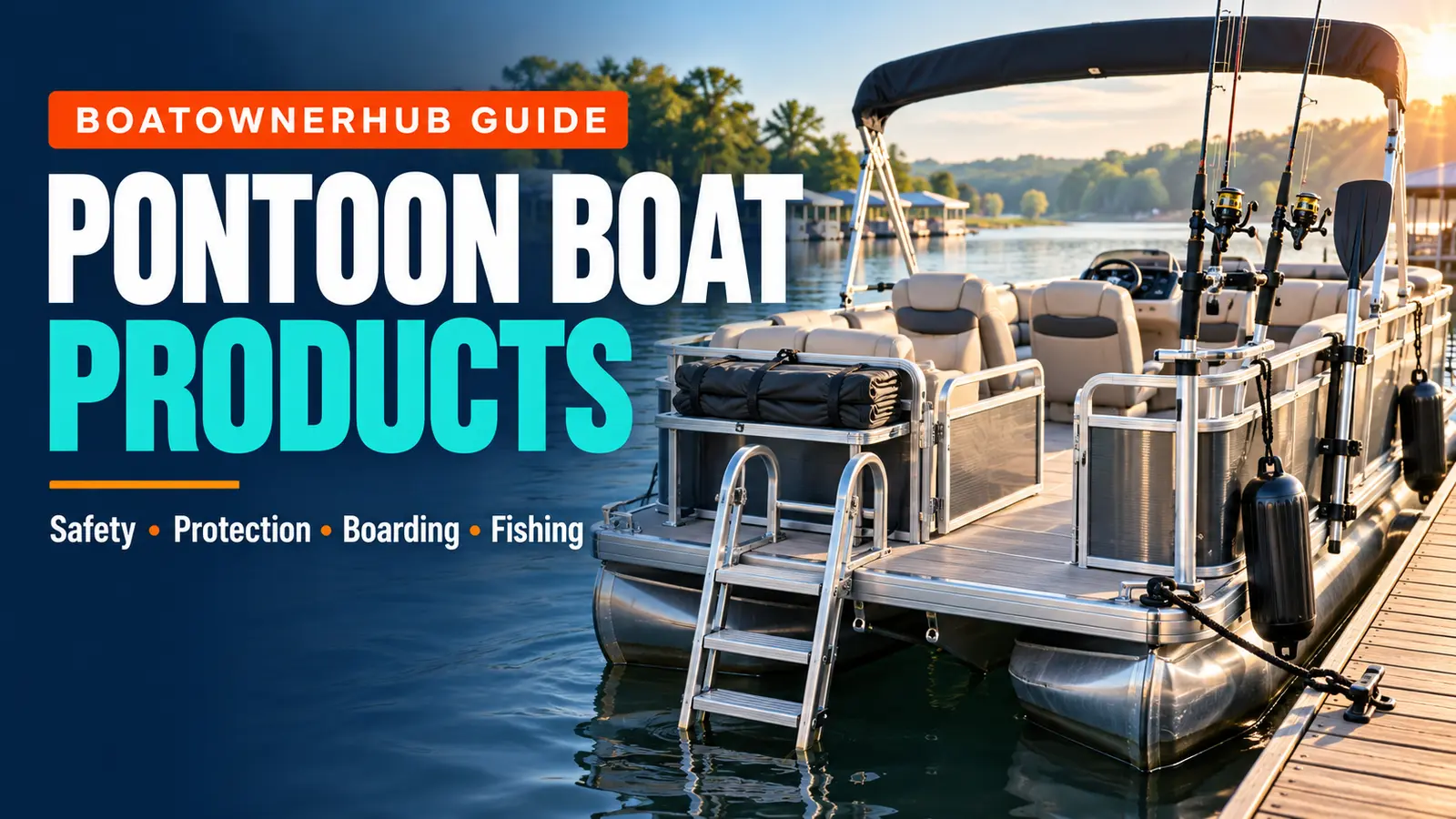
Editorial illustration of a generic pontoon setup. Exact products appear in the source-checked review sections below.
The most useful pontoon boat products solve a specific problem without blocking a gate, weakening a rail, overloading an electrical circuit or creating a trip hazard. Start with required safety equipment and reliable docking gear. Then consider a better boarding ladder, a correctly fitted cover, reachable backup equipment and fishing organization that matches your exact rail system.
Quick answer: what should you buy first?
- Safety and legal requirements: approved life jackets, communications, signaling, fire protection and navigation equipment for your boat and water.
- Docking and boarding: correctly sized lines, fenders and a ladder that fits the mounting area and users.
- Protection: a cover measured for the exact deck, beam, rails and projections, with the correct intended use.
- Backup equipment: accessible gear for close-range problems, not a substitute for propulsion or trip planning.
- Fishing organization: rail-compatible holders and storage that keep rods away from gates, controls and walkways.
Build a priority list around how you use the pontoon
A family day boat, fishing pontoon and overnight cruiser do not need the same accessories. Write down the repeated tasks that are awkward, unsafe or damaging. That list is a better starting point than a marketplace bestseller page.
| Priority | Problem it solves | Fit checks before buying | Main limitation |
|---|---|---|---|
| Boarding ladder | Safer water entry and exit | Mounting footprint, fasteners, clearance, step depth and capacity | May require structural mounting and careful installation |
| Pontoon cover | Reduces exposure during storage | Deck length, beam, console, rails, supports, vents and intended use | Poor support or fit can trap water and abrade surfaces |
| Telescoping paddle | Compact backup for limited close-range tasks | Collapsed length, reach and accessible storage | Not practical propulsion for a full-size pontoon |
| Rod holders | Keeps fishing rods organized | Rail profile, clamp range, load, rotation and gate clearance | Universal claims do not guarantee fit on every rail |
The Discover Boating pontoon-accessory overview is useful for brainstorming categories. For docking, prepare lines and fenders before the approach and account for wind, current and visibility, as outlined in its pontoon docking guide.
Use the boat safety equipment guide to verify required gear before optional pontoon accessories use deck or locker space.
Do not let optional accessories displace safety gear
Before using deck and locker space for convenience items, make sure required equipment is present, serviceable and reachable. Use the U.S. Coast Guard federal requirements guide as a federal baseline and confirm state rules. Its life-jacket guidance explains the wearable PFD requirement and why fit and condition matter.
Keep access to gates, controls, the engine, battery switches, fire extinguishers and throwable devices clear. A new mount or storage bin should not hide navigation lights, restrict visibility or create a sharp edge where passengers move.
Verified pontoon product options

Lippert SureStep Pontoon Boat Ladder
This five-step ladder can suit owners who need a deeper, more deliberate boarding route. Before ordering, verify the mounting footprint, deck clearance, fastener requirements and installation procedure on the exact pontoon.
- Useful for: boarding from the water where a five-step layout fits.
- Verify: the published 400-pound capacity, mounting surface and current instructions.
- Limitation: seller and manufacturer details are not perfectly aligned, and installation hardware or labor should not be assumed.
Two cover sizes for different pontoons
A cover must match the measured boat and the way it will be used. Measure the pontoon deck, beam and height, then account for consoles, rails, furniture, ladders and other projections. Use adequate supports and ventilation. If highway towing matters, require explicit approval from the cover and boat manufacturers rather than assuming a storage cover is towable.
| Reviewed cover | Best starting fit | What to verify | Complete review |
|---|---|---|---|
 SUPCVR 17–19 ft cover | Smaller pontoons within the selected 17–19 ft option | The listing also contains a 17–20 ft detail, so confirm delivered labeling, exact measurements, venting and storage use. | Read review |
 Solim 22–24 ft cover | Larger pontoons within the selected 22–24 ft option | Deck length, beam, projections, support system and listing-detail conflicts before relying on the size label. | Read review |
You can also browse pontoon cover categories at West Marine to compare cover types and measurement approaches. This is a category reference, not an endorsement of every listed cover.

Attwood 11826-1 Emergency Telescoping Paddle
The reviewed model extends to a listed 54 inches and packs smaller than a fixed paddle. On a pontoon, give it a realistic job such as close-range maneuvering or reaching an object, and keep it accessible.
- Useful for: a compact, clearly assigned backup role.
- Verify: locker clearance because published collapsed lengths conflict between 24 and 25 inches.
- Limitation: it is not a substitute for reliable propulsion and is unlikely to move a full-size pontoon effectively over distance.

PLUSINNO Dual-V Clamp-On Rod Holders, 2-Pack
These holders are a possible option for owners researching pontoon fishing boat accessories. The clamp, rail and rotation details matter more than the word universal.
- Useful for: organizing rods without a permanent mount when the rail is compatible.
- Verify: clamp opening, rail shape, rotation locks, strap use and clearance from panels and gates.
- Limitation: published clamp-size and rotation details conflict, so inspect the delivered hardware before trusting it with a rod.
Need an outdoor-storage cover shortlist? The heavy-duty pontoon cover review compares two verified size ranges, support requirements and important limitations.
Choosing electronics for a pontoon? Compare three verified fish finder packages for pontoon boats by screen, GPS, included transducer and installation scope.
Choose fishing upgrades around movement and rail fit
Useful pontoon boat fishing accessories should improve organization without turning the deck into an obstacle course. Place rod holders where they cannot swing into a gate, snag a line across a walkway or interfere with docking. Use retention straps where the instructions provide them, and remove or secure gear before trailering.
When comparing pontoon accessories for fishing, also consider where tackle, a landing net and electronics will go. High-load electrical additions require circuit protection, conductor sizing and installation that follow the boat and equipment manufacturers' instructions. For broader setup ideas, use the fishing boat accessories hub without assuming every fishing-boat product belongs on a pontoon.
Pontoon measurement checklist
- Record the boat year, make, model, deck length and beam from reliable documentation.
- Photograph and measure the rail profile, panel offset, mounting surface and nearby fasteners.
- Open every gate, seat base, hatch and changing enclosure through its full travel.
- Mark the path passengers use from each gate to the seating, helm and boarding point.
- Check visibility from the helm with the product installed and loaded.
- Confirm the mount will not hide required equipment or block access to controls.
- Match electrical products to voltage, current, protection, conductor and connector requirements.
- Read the pontoon and accessory manuals before drilling, clamping or adding structural loads.
Products to pause before adding
Some popular accessories deserve extra caution. A rail-mounted grill introduces heat, fuel and clearance questions. Replacement navigation lights must meet applicable visibility and installation requirements. Tow bars and sports attachments can apply large structural loads. Permanent rail modifications can weaken a component or affect a warranty. High-load audio, lighting, refrigeration and trolling equipment can exceed an existing circuit or battery plan.
If the instructions do not clearly cover your rail, deck, electrical system or intended use, contact the pontoon builder and product manufacturer. Do not use a marketplace photo as installation approval.
Protect the products after installation
Add each installed accessory to the boat's inspection routine. Check clamps, straps, fasteners, corrosion, movement and chafe before use. Dry covers and soft goods before storage, and keep drainage and ventilation paths open. The pontoon maintenance checklist connects accessory care with the tubes, deck, upholstery, outboard, electrical system and trailer.
Pontoon product questions
What pontoon boat products should a new owner buy first?
Start with required safety equipment and the gear needed to dock, anchor and board safely. After those needs are covered, prioritize protection from weather and products that solve a repeated onboard problem.
How do I know whether a pontoon accessory will fit?
Measure the exact rail shape, mounting surface, gate clearance, deck length, beam and nearby obstructions. Match those measurements to the product instructions and the pontoon builder's restrictions before drilling or clamping.
Can I tow a pontoon with a storage cover installed?
Only if the exact cover and boat manufacturers explicitly approve that use and every support, strap and speed limitation is followed. A product described for storage is not automatically suitable for highway towing.
Do pontoon fishing accessories need special mounting hardware?
Many do because pontoon rails vary in profile, thickness and panel clearance. Confirm clamp range, load limits, backing requirements and whether the installation could damage the rail or interfere with gates and walkways.
Is a telescoping paddle useful on a pontoon?
It can serve as a compact backup for close-range maneuvering or reaching an object, but it is not a substitute for reliable propulsion, an emergency plan or the safety equipment required for the trip.
Sources and editorial method
BoatOwner Hub used official federal safety guidance, independent boating education sources and the exact published review research for each named product. Product identity, selected variant, material claims and discrepancies were checked in the corresponding review. This is selection guidance, not hands-on testing or installation approval.
- U.S. Coast Guard: A Boater's Guide to Federal Requirements
- U.S. Coast Guard: life-jacket guidance
- Discover Boating: pontoon accessory categories
- Discover Boating: how to dock a pontoon
Use the Product Finder
Choose Boat Products, select the category and open only published BoatOwner Hub reviews that match the job.